

Excellent research from Eberswalde: BioThesis Awards 2026
Sustainable agriculture does not begin in the field. It begins where people bear responsibility, businesses must make decisions, and new ideas encounter existing structures. Two theses from the Eberswalde University for Sustainable Development (HNEE) demonstrate how scientific research addresses precisely these issues — and were recognised for this with the BioThesis Research Award 2026.
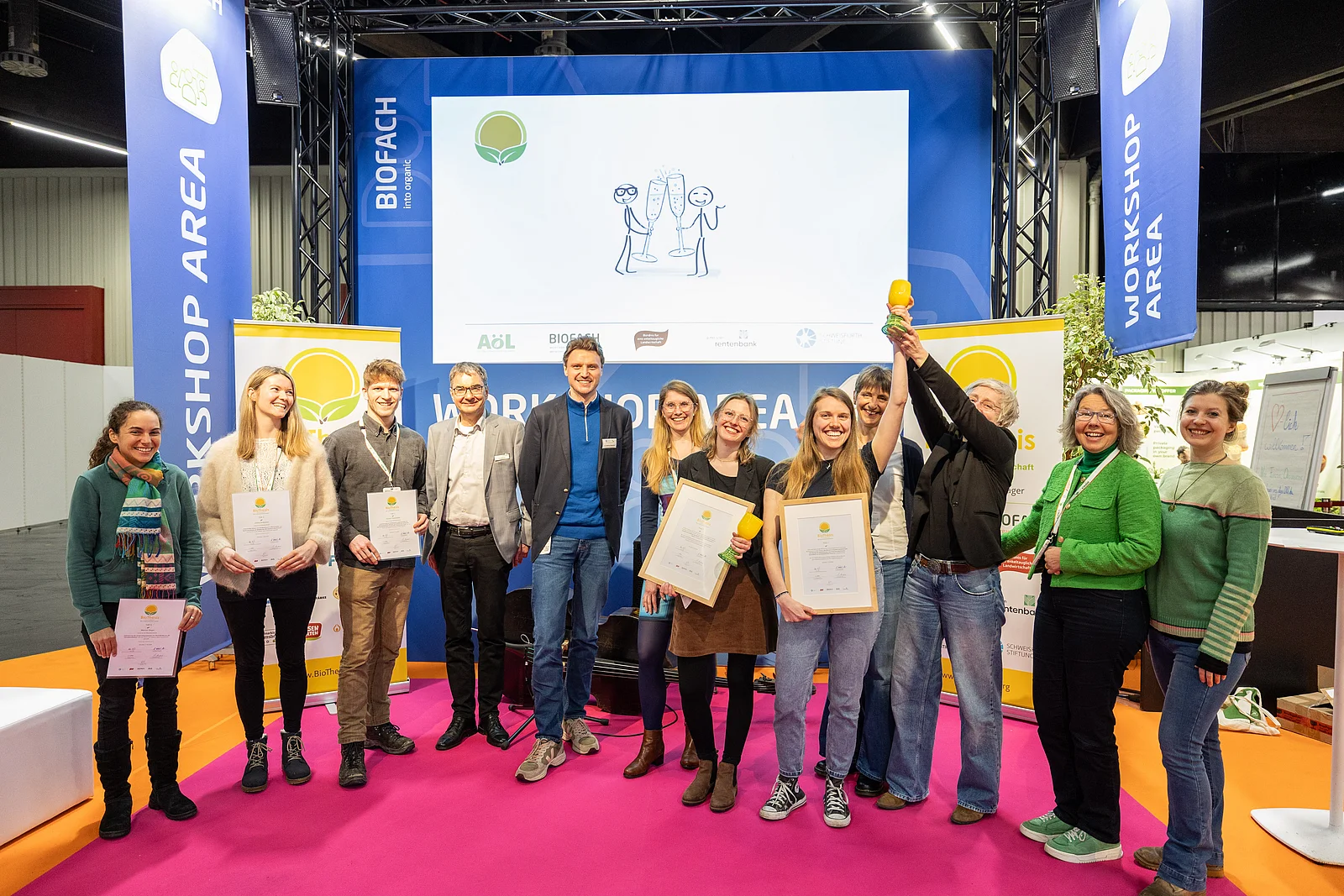
At the international organic trade fair BIOFACH in Nuremberg, Master's graduate Julia Dahl received the award for the best Master's thesis. Florian Fassbinder's Bachelor's thesis was voted one of the three best Bachelor's theses of the year. Both theses are examples of research that not only analyses, but also enables change.
Agriculture is under pressure: economic uncertainties, social expectations and a high workload characterise the everyday life of many farms. In her Master's thesis, Julia Dahl addressed a question that has long been neglected in scientific research: how do people in agriculture maintain their mental health? Under the title "People in the agricultural system – the contribution of self-care to maintaining mental health", she examined the role of self-care in everyday farm life. To this end, she developed an innovative interview format that structured conversations as joint reflection processes and highlighted personal experiences as well as structural relationships within agricultural businesses.
"Julia Dahl combines scientific precision with great sensitivity to the realities of life on family farms. The reactions to her work already demonstrate the relevance of the topic," says Dr Marianne Nobelmann, who supervised the work. For Julia Dahl herself, the conclusion is clear: "When we talk about sustainable agriculture, we also have to talk about how the people who support it are doing. Self-care is not a luxury, but a prerequisite for being able to take on long-term responsibility." The results are already resonating beyond the scientific community and are being taken up in consulting and specialist circles.
New ideas need appropriate rules. Florian Fassbinder also addressed a key question for the future of sustainable agriculture: how do new community-supported economic models fit into the existing legal framework? Solidarity-based agriculture connects producers directly with consumers and strengthens regional supply chains. At the same time, many of these farms find themselves in legal grey areas – for example, in construction, tax or social security law.
Fassbinder analysed affected farms nationwide and developed concrete recommendations for action for administration, politics and practice. "The work highlights where innovative agricultural models clash with existing structures. Florian Fassbinder succeeds in preparing complex questions in this field in a scientifically sound manner while at the same time developing solution-oriented perspectives," explains Prof. Dr. Jens Pape, supervisor of the bachelor's thesis. Florian Fassbinder says: "Community-supported agriculture is a very special form of direct marketing that gives many young businesses economic prospects. For these initiatives to develop, authorities are needed that are willing to break new ground."
Research that makes an impact: The awards show how closely research, practice and social transformation interact at HNEE. Both theses combine scientific depth with concrete benefits — for agricultural businesses, consulting, administration and political decision-making processes. They make it clear that sustainability means more than just ecological indicators. It also concerns health, cooperation and the question of how new ideas can find their place in existing systems.
You can find Mrs Dahl's master thesis here.