

Sustainability Barometer 2025: Young generation calls for political responsibility – education for sustainable development gains importance
Socio-economic issues, justice and political reliability are increasingly becoming the focus of young people's understanding of sustainability in Germany. This is shown by the Greenpeace Sustainability Barometer 2025, a nationwide representative study conducted by the Eberswalde University for Sustainable Development (HNEE) in collaboration with Greenpeace e. V. and Leuphana University Lüneburg. A total of 1,506 young people between the ages of 15 and 24 were surveyed in June 2025.
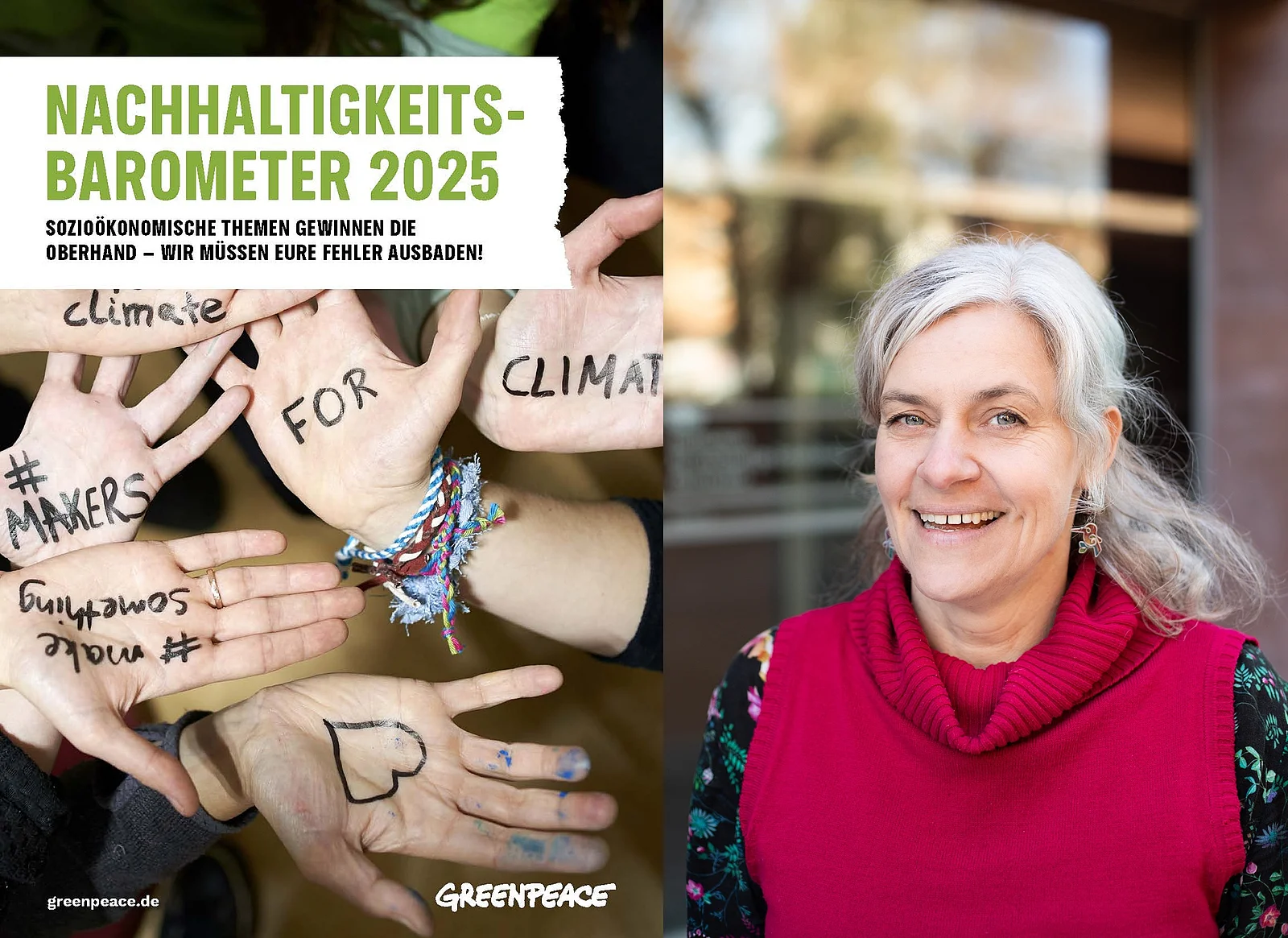
The results clearly show that sustainability remains a key issue for the younger generation, but is increasingly linked to social issues, the cost of living, intergenerational justice and political responsibility.
Sustainability remains relevant – priorities are shifting
Environmental and climate protection continue to be important issues for young people, but are losing relative importance compared to previous surveys. Instead, social security, living costs and issues of justice are becoming significantly more important. Respondents cite respect for human rights as the most important sustainability-related issue, followed by good financial security for all.
More than 70 per cent of young people agree with the statement that they have to pay for the mistakes of older generations in dealing with the environment and climate. A majority also feel that the disproportionate greenhouse gas emissions of the richest people in Germany are unfair and feel let down by politicians when it comes to environmental and climate protection. Background: One person from the richest 0.1 per cent of the German population is responsible for 307 tonnes of CO₂ per year. The poorest 50 per cent, with annual per capita emissions of 5.9 tonnes of CO₂, are comparatively close to the 1.5-degree-compatible limit of 2.1 tonnes of CO₂. Two-thirds of young people consider this imbalance to be unfair. (The figures are taken from the OXFAM report "Climate Gap" from October 2025).
"Many young people have a very clear understanding that ecological crises and social inequality are closely linked," says Sonja Geiger, professor at HNEE and co-author of the study. "At the same time, there is growing frustration that this awareness is hardly being addressed politically."
Research focus: Justice and climate emotions
Prof. Dr. Sonja Geiger was particularly involved in the design and further development of the questionnaire and the statistical analyses as part of the Sustainability Barometer. In terms of content, her focus was on justice issues and climate emotions – in other words, the question of how young people perceive inequality, responsibility and psychological stress in the context of climate change.
"What is new about this survey is that we are no longer just talking about opinions and wishes with regard to sustainable development, but increasingly about climate justice and the psychological stress young people experience as a result of climate change," explains Geiger. "This perspective is crucial for understanding current social tensions."
The tension between Greenpeace's pragmatic, policy-advising approach and a scientifically based approach that also reveals complex multivariate relationships is particularly challenging and at the same time productive.
Why the Sustainability Barometer is so important
The Greenpeace Sustainability Barometer provides a particularly reliable picture of the young generation in Germany. In addition to the representative sample, internationally established measurement instruments are used in some cases, for example to record climate emotions. It is also a time series that has already been collected for the fourth time.
"This allows us not only to provide snapshots, but also to track rough trends over the years," says Geiger. "This makes the results particularly valuable for science, politics and education."
Education for sustainable development: guidance in times of crisis
A key finding of the study is the growing importance of education for sustainable development (ESD). Sustainability is now much more firmly anchored in schools, training and universities than it was ten years ago. Depending on the educational sector, between 61 and over 90 per cent of respondents say they have already dealt with sustainability in class.
At the same time, the study shows that the implementation of ESD often remains selective – limited to individual subjects or short projects, for example. Students, especially at universities, would like to see greater integration of teaching, institutional practice and social responsibility.
"Education for sustainable development is an important anchor for many young people in dealing with the multiple crises of our time," says Geiger. "However, for ESD to be effective, more than just factual knowledge and methodological skills are needed."
HNEE: Space for action competence and democratic participation
Against a backdrop of growing concerns, frustration and political disillusionment, Geiger sees a special responsibility for universities – and explicitly also for HNEE.
"In addition to specialist knowledge, young people need intrapersonal skills," she emphasises. "In other words, the ability to deal with feelings such as fear, overwhelm or anger and to channel them constructively – for example, through social support or engagement in their own environment, rather than falling into paralysis."
Active interventions for psychological support in dealing with multiple crises are therefore an important part of contemporary education for sustainable development. The results of the Sustainability Barometer thus underline the role of HNEE as a place of reflection, scientific classification and active shaping of social transformation.
"Education cannot solve all social problems," says Geiger. "But it can open up spaces in which young people can develop confidence, judgement and democratic competence – and that is precisely what is crucial today."
The Sustainability Barometer “Nachhaltigkeitsbarometer 2025 Sozioökonomische Themen gewinnen die Oberhand – Wir MÜSSEN eure Fehler ausbaden!”
Autor Dr. Dietmar Kress, can be found here. The OXFAM report mentioned above can be found here.