


Personalised course content
Your degree programme is a personalised learning journey towards becoming a person who thinks and acts in a socially entrepreneurial and sustainable way. In the Social Innovation Project (SIP), this begins with exploring your own personality in order to form a team and analyse a problem of your own choosing. Building on this, you will develop and test sustainable social ideas, which you will then refine into an economically viable concept. These are evaluated with a focus on impact and put into practice. Elective and advanced modules, as well as intercultural experiences, will accompany you on your journey.
(copy 1)
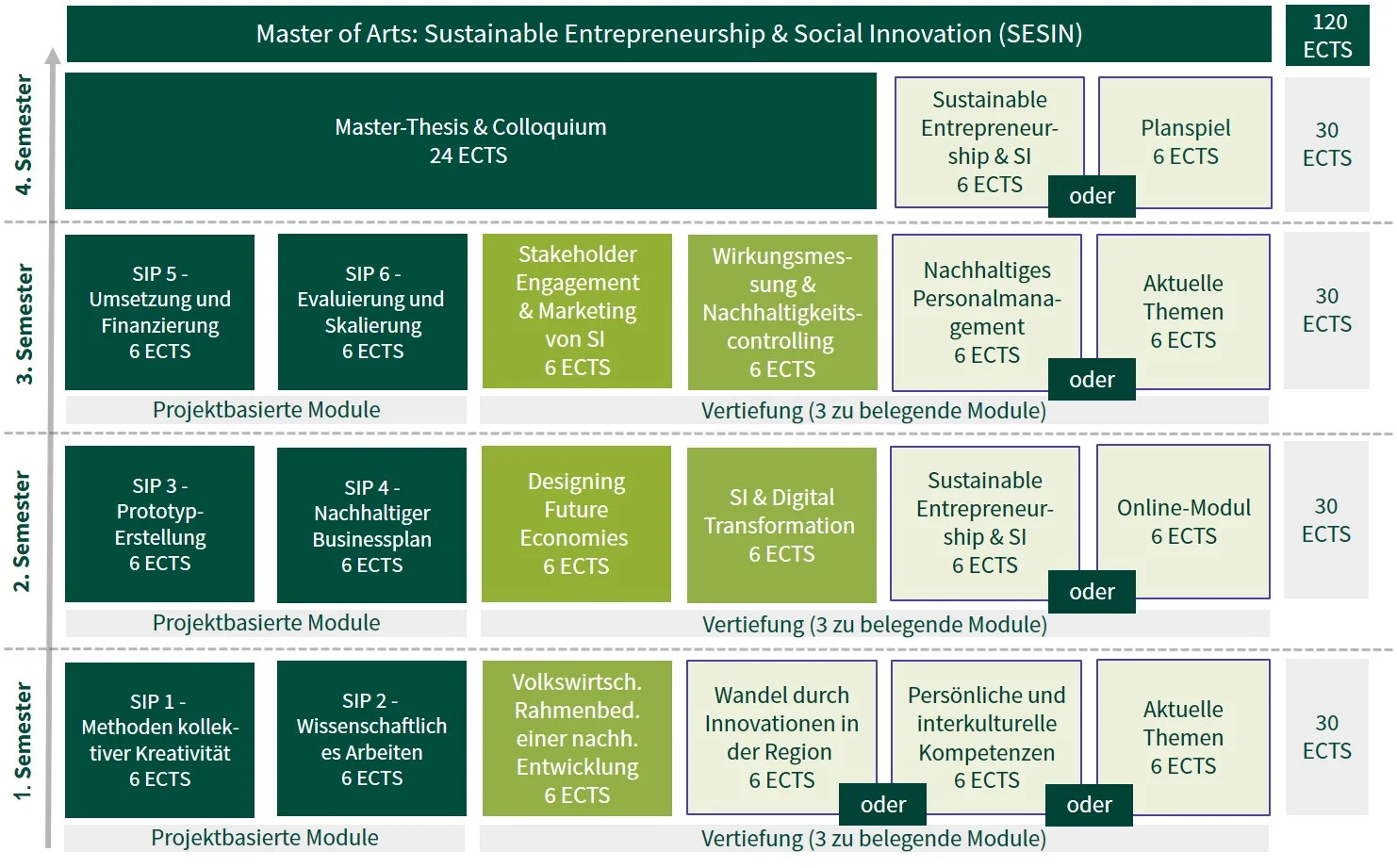
Modules per term
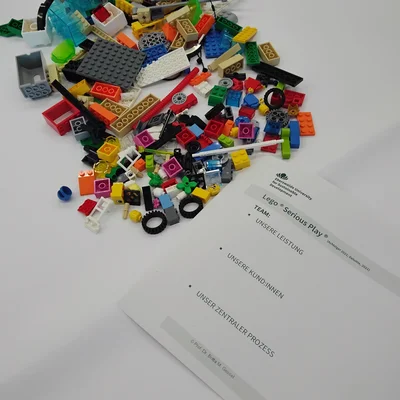
In the first semester, you will form skills-based teams and use collaborative creativity techniques and in-depth problem analysis to identify topics for your social innovation projects. You will also explore the personal, intercultural and macroeconomic aspects of social transformation.
This module teaches you the fundamentals and practical aspects of team dynamics and team learning processes, and fosters the development of individual and collective creativity. The team-oriented learning and personal skills you acquire contribute to the overall objective of all six SIP modules.
You will develop your analytical skills by independently tackling both a theoretical research question and a complex practical problem analysis, drawing on academic knowledge and methodology. The problem analysis is closely linked to the brainstorming process in SIP 1.
Through a combination of theory and practical examples, you will gain an understanding of regional economic issues and approaches to development. Using design thinking, you will then develop your own socially impactful ideas to address problems in rural areas of Brandenburg.
In this module, we examine the macroeconomic conditions within which sustainable economic activity can take place. You will learn about concepts, strategies and approaches to shaping sustainable development from a variety of perspectives, with a view to fostering your systemic thinking.
The aim of this module is to develop personal and intercultural skills. Self-assessment exercises in the context of intercultural learning and working environments will help you develop the cognitive and behavioural skills needed for respectful and effective intercultural communication.
This module serves as a core module for courses on current topics in theory and practice. These include modules such as Sustainable Design and The Economics of Happiness. In addition to courses offered by HNEE, you may choose suitable courses from other Master’s programmes both in Germany and abroad.
In the second semester, you will hone your entrepreneurial mindset whilst developing prototypes and business plans based on your ideas as part of the Social Innovation Project. In further modules, you will develop normative narratives for a more sustainable future and learn about the role that digitalisation can play in social transformation.
This module serves as a core module for courses on current topics in theory and practice taught in English. These include modules such as Sustainable Design and The Economics of Happiness. In addition to courses offered by HNEE, students may choose suitable courses from other Master’s programmes both in Germany and abroad.
Get out of the seminar room. With Design Thinking, you iteratively develop a prototype based on your innovative idea by analysing the needs, expectations and willingness to pay of potential customers. This process focuses on direct interaction with customers and partners from the real world.
Working in collaboration with industry partners, you will develop a financially viable, impact-oriented concept that covers all relevant aspects (business idea, team, market analysis, marketing and sales, company & organisation, financial planning, funding) based on your idea, and will ultimately pitch it to a jury of experts.
Organisational, technological and social innovations are helping to solve some of the world’s most pressing problems. You will explore these possibilities during an excursion and learn about the role that digitalisation can play in social transformation.
This module offers you a creative, collaborative learning environment in which you use scenario-building techniques to develop narratives of a better future. Through partnerships with universities in countries of the Global South, this module has an international and multi-perspective focus.
In the third semester, the focus is on public communication, financing, scaling up and measuring the success of social innovations. As part of the Social Innovation Projects, you will launch a crowdfunding campaign for your innovative idea and put an initial pilot project into practice.
You will put your social business idea into practice through pilot projects in collaboration with industry partners. In addition, you will apply for funding by entering a business plan competition. You will learn about systemic coaching methods and apply them when advising other student teams.
You will evaluate your social enterprise activities through field research and calculate the social impact of your SIP. In addition, you will carry out calculations regarding potential scaling and its effects on financial viability and social impact, and present the findings in the form of a crowdfunding campaign.
This module introduces you to the key tools for communicating and marketing social innovations, and uses real-world examples to highlight the importance of authentic branding, pricing and integrated marketing communications. Drawing on what you have learnt, you will develop a marketing campaign for social sector partners.
With a sustainable and innovative approach to human resources management, you can meet the challenge of attracting qualified and motivated staff and retaining them in the long term.
Social impact and sustainable business practices are becoming increasingly crucial to a company’s success. You will be introduced to various sustainability reporting frameworks and learn how to apply tools and methods for measuring impact and performance management.
This module serves as a core module for courses on current topics in theory and practice. These include modules such as Sustainable Design and The Economics of Happiness. In addition to courses offered by HNEE, you may choose suitable courses from other Master’s programmes both in Germany and abroad.
In the fourth semester, the individual learning journey culminates in a final reflection using a simulation exercise and the writing of a Master’s thesis, a process which is supported by a seminar providing guidance on the key steps and methods of academic research.
This module focuses on teaching the distinctive features of setting up a business for the public good in an engaging way. It provides an opportunity to reflect once again on the entire learning journey you have undertaken throughout your degree via the Social Innovation Projects.
You will write your master’s thesis either in conjunction with your social innovation projects or on any topic that is consistent with the course content. We, the teaching staff, will guide you through the process. You will present your findings on an ongoing basis as part of a seminar.
FAQ: Course Content
No, the students choose the topics themselves in their groups during the first semester.
In principle, it is possible to incorporate existing ideas into the SIP. However, all ideas must be developed in groups. Students who already have ideas must therefore convince other students to work on their idea together. In principle, however, you do not need to bring an idea with you; they are developed collectively.
No, students choose their own groups during the first semester.
Yes, at the start of the second semester, students have the option to switch teams; however, it remains compulsory to work in teams throughout the second semester. At the start of the third semester, there is another opportunity to switch teams, and from this point onwards, individuals may also work on a project idea.
Yes, at the start of the second semester, students have the option to change their topics; however, working in teams remains mandatory throughout the second semester. At the start of the third semester, there is another opportunity to change topics, and from this point onwards, individuals may also work on a project idea.
The SESIN is a full-time degree programme in which attendance is essential due to its project-based learning approach. Holding a part-time job is not strictly prohibited, but it should be carefully considered and, where possible, arranged to allow for flexible working hours so that you can meet the demands of the course
A consecutive Master’s degree is a postgraduate programme that generally builds on a Bachelor’s degree in the same subject area. In the case of SESIN, this means that, despite links to other social science disciplines, the programme is primarily focused on business administration.
This module serves as a framework for courses on current topics in theory and practice. These include modules such as Sustainable Design, The Economics of Happiness, and research seminars on social entrepreneurship and social innovation. In addition to courses offered by HNEE, students may choose suitable courses from other Master’s programmes both in Germany and abroad.
At SESIN, it is best to undertake a semester abroad during or after the third semester. Partnerships with suitable partner universities in Europe and overseas are in place and are being further developed.