

Roundworm, chicks, forest and survival – HNEE research makes a difference
For Prof. Dr Eva-Maria Saliu, Vice-President for Research and Knowledge Transfer at the Eberswalde University for Sustainable Development (HNEE), one of the university’s particular strengths lies in the close link between sustainability, practical relevance and research excellence. At HNEE, sustainability is not merely an additional feature of the institution’s profile, but is deeply embedded in its structures and thus forms part of its core identity.
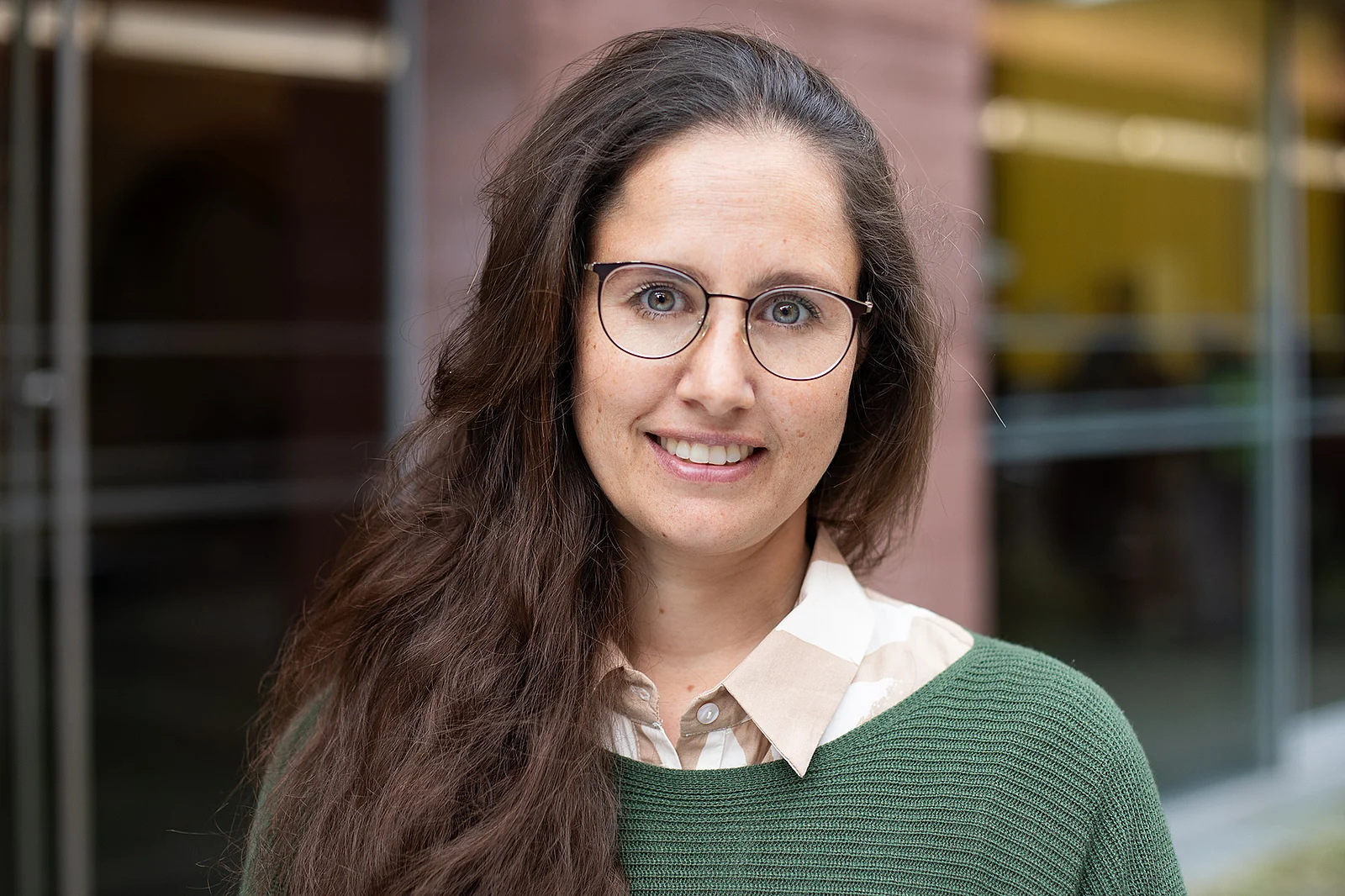
Eva-Maria Saliu, who has a background in veterinary medicine and animal nutrition, sees this as precisely what sets the university apart from many others. Research at the HNEE often arises from specific questions and practical needs. Basic research is also carried out at a university of applied sciences – yet at the same time, the focus is always on the challenges facing the field and the solutions required. In this way, the HNEE works with industry partners to find answers to local problems within a global context.
The close interaction between research and application is evident across a wide range of subject areas: for example, in studies on roundworm infections in humans and animals, which combine laboratory-based basic research with observations under practical conditions. Research into chicken breeds, feeding strategies and animal health also addresses specific questions from agricultural practice and develops scientifically sound findings from them.
In this context, knowledge transfer is not a downstream step, but is integrated into many projects from the outset. Through structures such as INES or InnoSupport, the HNEE creates the right conditions for taking on practical questions, incorporating them into research and teaching, and feeding results back specifically to the region, farms and businesses. This makes knowledge transfer more than just a final report – it becomes a genuine investment in regional development.
HNEE’s research priorities also emerge from this interplay. Sustainable landscape management in forests and open-land systems is just as much a defining theme as socio-economic issues relating to business and society. Research, transfer and teaching are closely intertwined at HNEE – and that is precisely what makes the university strong.
Looking ahead, it is essential to further build on these strengths: through high-profile institutes and centres, better support for early-career researchers, stronger infrastructure and reliable project management support. In this way, HNEE can further refine its role as a research-active, practice-oriented and sustainability-focused university.
The full interview with Prof. Dr Eva-Maria Saliu demonstrates how and why research at HNEE is not only application-oriented but also effective.
A conversation with Prof. Saliu about research at HNEE
Question: You are responsible for research and knowledge transfer at a university with a clear focus on sustainability. What attracted you to HNEE?
I originally come from the Free University of Berlin, where I studied veterinary medicine – specifically animal nutrition. What attracted me to the HNEE is its strong research focus as a university of applied sciences – and, of course, the concept of sustainability. I have long been interested in how animal nutrition and animal husbandry can be made more sustainable. Sustainability is not a new topic for me. Before I became a vet, I actually studied physics for a while – with the aim of becoming a climate researcher. In that sense, coming to HNEE has brought things full circle for me in a way.
Question: Many universities have sustainability in their portfolio. What do you think sets the HNEE apart?
At the HNEE, sustainability isn’t something that’s been added on as an afterthought. It’s so deeply embedded in the structures that it’s become a matter of course. That’s exactly what sets the university apart from many others, in my view. Here, sustainability is taken into account everywhere – and often so naturally that there’s no need to constantly highlight it separately. Sustainability is also firmly embedded in research and knowledge transfer, not just thematically but conceptually: systems research runs like a thread through the various multidisciplinary projects. Added to this, for me, is the strong disciplinary focus on agriculture, land use and related fields, which fits very well with my own research topics.
Question: What role do universities of applied sciences play in societal transformation processes – and what distinguishes their research from university research?
For a long time, the prevailing view was that teaching was the primary focus at universities of applied sciences and HAWs. However, I am witnessing a significant shift. Many colleagues want to do more than ‘just’ teach – out of scientific curiosity, out of personal motivation, and because they want their work to make a contribution to society. At the same time, research is also important for teaching: those who are not part of scientific communities quickly lose touch with current developments.
What distinguishes us from universities – not fundamentally in terms of quality, but often in terms of focus – is our strong connection to practice. We, too, conduct basic research. But we always ask: What problems exist in the field? What solutions are needed? Much of our work arises from the specific needs of our partners in the field, rather than solely from what is currently particularly prominent or citable in academic circles. In this way, at HNEE, we work together with the relevant stakeholders to find answers to pervasive, local problems and challenges within a global context.
Question: Could you illustrate this with an example?
One example is our research into roundworm infections in humans and animals. On the one hand, we conduct very basic research in the laboratory to investigate how the immune system, intestinal epithelium, bacteria and worm eggs interact. On the other hand, we work directly under practical conditions, for example on farms with pigs or chickens, and track natural infection pathways there. This is highly relevant for agricultural businesses because it allows us to draw conclusions about routes of infection, animal health and even the success of vaccination.
Another example is our research into different chicken breeds and origins, and into how they cope with feed of varying nutrient density. One of the reasons for this was the ban on the culling of male chicks. This raised very practical questions regarding the rearing and feeding of male animals. Here, too, we start with a real-world problem and combine it with laboratory work, for example on meat and egg quality or on the effects on animal health and behaviour.
Farge: If research at universities of applied sciences is increasing, where does the transfer of knowledge fit in?
The alignment with university research primarily concerns the scope and quality, not the way we work. Researchers at HNEE secure significant external funding – but knowledge transfer is always strategically embedded within the projects. This is precisely where a particular strength lies. In our chicken example, for instance, we are establishing a network in Brandenburg where businesses involved in chicken farming, processing and marketing meet regularly to supply the local market with regional products. Such initiatives do not always immediately generate traditional scientific output, but they are hugely important for knowledge transfer. Unfortunately, the impact of scientific work is often not yet given due recognition in excellence assessments. This would be important in order to assess research at universities of applied sciences more fairly in terms of excellence.
At HNEE, with INES, InnoSupport and other structures, there are excellent conditions for taking on practical issues, incorporating them into research and teaching, and then specifically feeding the results back into the region, into farms and businesses. This is more than just publishing a final report or a paper. It is a genuine investment in our region.
Question: How are HNEE’s research priorities developing?
Research priorities cannot be designed on the drawing board. They emerge from what actually happens at the university: from publications, the acquisition of third-party funding, collaborations and the topics that colleagues are advancing in their research. That is why their development is also a collaborative process within the university. Last year, the new research priorities emerged through participatory exchange formats, both in person and online.
It is currently very clear that sustainable landscape use – in forests as well as in open-land systems – remains a central theme. In view of the climate crisis, with its droughts and extreme weather events, this will continue to be highly relevant in the future. At the same time, the HNEE possesses strong socio-economic expertise and actively conducts research into current and forward-looking topics in business and society. How these priorities develop also depends on which new colleagues join the university and the topics they bring with them.
Question: How closely are research priorities and practical application linked at the HNEE?
Very closely. For example, in the field of sustainable landscape use, we are constantly approached with practical questions – from agricultural businesses, from the forestry sector or via networks such as INES. This gives rise to research projects, publications and third-party funding. In this respect, the research focus itself also arises from practical needs and questions.
For a university like HNEE, research, knowledge transfer and teaching can hardly be neatly separated anyway. They are closely intertwined. That is precisely part of our strength.
Question: HNEE operates at regional, national and international levels simultaneously. Why are real-world laboratories and regional networks so important for sustainability research?
They are an enormous resource for us. Research does not take place in isolation, but through exchange – in networks, collaborations and joint projects. Real-world laboratories and similar structures help to conduct research in a concrete context under real-world conditions whilst remaining connected to larger scientific networks.
This is particularly relevant for funding applications, because it is not only technical and methodological expertise that counts, but also the question of what infrastructure and access one has at one’s disposal. In this respect, such structures are not necessarily the only prerequisite for sustainability research – but they make many things significantly easier to achieve.
Question: At HNEE, ecological, social and economic perspectives come together. How does this interaction work?
In my view, the best research projects are those in which different areas of expertise come together. No one can fully grasp a problem from the perspective of a single discipline alone. In sustainability research in particular, it is important to combine perspectives from the natural sciences, social sciences and economics.
At the HNEE, we actively promote this multidisciplinary collaboration. The Biosphere Reserves Institute is a good example of this, as it brings together different disciplinary approaches. Looking ahead, we would like to create further structures in which we can work together on larger-scale issues.
Question: Does the HNEE need more research centres and institutes for this?
Yes, absolutely. A major challenge for universities of applied sciences is that, compared to traditional universities, they undertake significantly more teaching whilst having significantly fewer mid-level academic staff. Many tasks for which universities provide postdocs or administrative support remain the responsibility of the professors themselves at universities of applied sciences. In institutes and centres, expertise, administration and the promotion of early-career researchers can be better pooled. Furthermore, a sense of community is fostered, which boosts research and transfer projects and improves the mental wellbeing of researchers.
Such structures are also important externally. For industry partners, it is easier to find a visible research centre on a particular topic than to contact individual people directly. Collaborations are more sustainable when several people maintain the partnership. Centres and institutes create reliability, visibility and better accessibility.
Question: Looking at the HNEE in five years’ time: where should the university be then?
I would like to see at least two well-established institutes at the HNEE, where professors work together with their research groups on major, cross-departmental topics and submit joint grant applications. In addition, I would like to see smaller, thematically focused centres that also strengthen collaborative research and knowledge transfer.
I would also like to see significantly better support for early-career researchers – from undergraduate or Master’s theses right through to a professorship at a University of Applied Sciences – strengthening of the mid-level academic staff, improved infrastructure, reliable support for project management, and, overall, more time for research and knowledge transfer for researchers, with a reduced administrative burden. It is also important to me that we not only implement measures but also systematically evaluate their impact. And I would like to see the Brandenburg Doctoral College get off to a quick start, so that academic careers at a university of applied sciences become even easier to plan and support.
The interview was conducted by Ulrich Wessollek.