


Personalised course content
The degree programme is consistently aligned with the principles of Education for Sustainable Development (ESD). The programme concept is based on six interdisciplinary key competencies for sustainability: value orientation, systems thinking, future-oriented thinking, strategic thinking, implementation skills and collaborative skills, closely interwoven with specific subject-area competencies. This represents a paradigm shift in programme development, as the key competencies for sustainability enable us to align the entire learning process with cross-programme learning objectives.
Modules per term
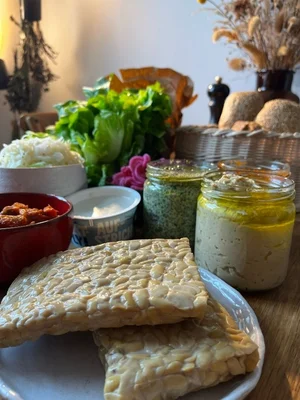
In the first semester, you will explore the diverse range of perspectives on agricultural and food culture and sustainability. Through artistic and creative approaches to agricultural and food culture, you will gain new perspectives and learn the fundamentals of sustainable food production and plant-based health. You will also acquire a methodological foundation for academic work.
You have mastered the core techniques of academic research and can apply them across disciplines in your studies; you are also able to organise work processes for the collaborative production of academic work. You are familiar with the fundamentals of descriptive and inferential statistics.
You are familiar with systems theory approaches in sustainability studies and are able to identify ecosystem compartments, recognise ecosystem interactions and draw detailed, interdisciplinary links to sustainable development. You have a broad understanding of the key debates in the field of sustainability.
You will learn about the fundamentals of sustainable food production and raw materials, as well as the core concept of planetary health for sustainable food systems. You will gain an understanding of the local, global, cultural and technological aspects of food, and actively develop a fundamental understanding of food systems and their subsystems.
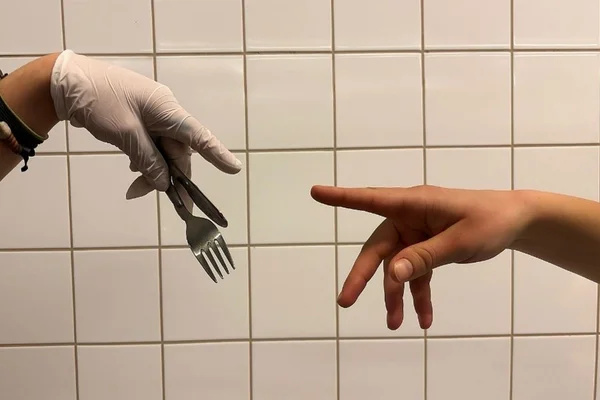
They explore the connections between art, food and agriculture. The module focuses on creative and aesthetic approaches to develop a deeper understanding of the significance of food and agriculture in our society. It offers ideas on various ways of engaging with existing knowledge and on shifting perspectives on sustainable cultures and development.
Sub-module ‘Economics’:
You will be able to place the agricultural and food industry within the broader context of the economy. You will understand decision-making behaviour and the interactions between people, and will be able to reflect on economic and socio-political mechanisms for the efficient allocation of scarce social and natural resources.
Sub-module “Introduction to Business Administration”:
You will be able to identify the fundamentals and objectives of business decision-making, contextualise them, and apply key business management concepts with confidence. You will solve decision-making problems within individual businesses and apply operational and strategic (planning) tools for sustainable business management.
The second semester explores the challenges and opportunities within the current agricultural and food culture. In the project module ‘Study Partners in the Organic Sector’, you will gain your first experience of transdisciplinary collaboration. In the module ‘Effective Sustainable Action’, you will learn about the theoretical and methodological foundations of transformation research.
You will gain initial practical experience in the workplace and learn to coordinate a project as part of a group. You will apply your knowledge independently and take ownership of the process, thereby gradually arriving at a solution. Technical and methodological support and guidance will be provided by a partner organisation and a specialist lecturer.
You will gain a basic understanding of sustainable land use practices in agriculture, forestry and tourism, in the context of current challenges such as climate change and biodiversity loss. You will understand the constraints under which land users operate (economic, political and legal frameworks). You will analyse the conflicts and synergies arising from the conservation and sustainable use of ecosystems.
You are familiar with the fundamental concepts, principles and methods of transformation research, which focuses on the study of processes of change towards a sustainable society. You are able to apply these principles to case studies and discuss them.
You will learn to understand the strategic and operational marketing approaches of key players in the agricultural and food industries. You will acquire the knowledge and methods needed to develop, make and implement well-informed marketing decisions.
The third semester is themed ‘Exploring Potential’. You will begin an eight-week supervised practical placement at companies within our network of partner organisations. In the ‘Food Systems Policy’ module, you will examine the diverse perspectives of stakeholders and the impact of legislation on social reality.
You will gain practical insight into a sector of the agricultural and food industry through a work placement with a company or organisation within the food system. You will have the opportunity to reflect on your experiences in relation to sustainable development within the food system and food culture.
You are familiar with the process chains for key food products (e.g. ecological footprint, carbon footprint) as well as the basic processes involved in industrial food processing. You understand the impact of food processing, transport and storage on food properties and quality. You are able to carry out simple sensory tests on food.
You will understand the psychological foundations of nutrition and how psychological factors influence eating habits in different contexts and cultures. You will understand ethical issues relating to nutrition and sustainability and be able to reflect on your own eating habits. You will learn how to apply psychological principles and techniques to promote healthy eating habits.
They are able to assess the effects of policy interventions in the food system from an individual, regional, sectoral and macroeconomic perspective.
The fourth semester is all about ‘building bridges’. In the project module ‘Food Systems of the Future’, you will work with local stakeholders to develop exemplary solutions to problems. You will refine your profile through your chosen topic and, where applicable, with the support of a supervisor. You will also choose a specialisation from six compulsory-elective modules.
In this interdisciplinary and transdisciplinary project, you will work as part of a team to apply the specialist and methodological knowledge and practical experience you have acquired so far to your own self-directed project, in collaboration with a local stakeholder. In doing so, you will deepen your experience in shaping co-creative processes at the interface between science and society. Through this intensive engagement, you will gain a deeper understanding of the interrelationships and scope for action regarding a specific aspect within the context of local food systems.
You will gain a basic understanding of nutritional physiology and biochemical processes in the body. You will understand the links between food components and diseases, as well as the benefits of functional foods (dietary supplements). You will be able to communicate complex relationships between nutrition, health and sustainability to different target groups.
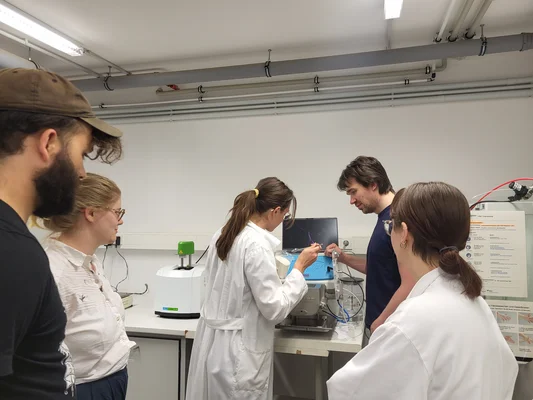
This module will equip you with the fundamental knowledge and skills required for the development of innovative and sustainable food products. It combines theoretical concepts with practical laboratory exercises to give you a comprehensive insight into the product development process.
Students are able to understand the complex interactions between climate change, its main drivers and impacts, as well as the policy and governance responses at various levels.
You will develop an understanding of innovative economic approaches and indicators within the sustainable agriculture and food sector. You will critically examine traditional economic models and be able to envisage alternative concepts. You will be able to identify and evaluate innovative and sustainable economic approaches within the agriculture and food sector, and apply them in your future professional practice.
They view the landscape as a shared space – which gives rise to a whole range of communication challenges. They learn to apply well-considered communication strategies so as not to get lost in individual perspectives, and are able to develop a shared vision with all stakeholders of how the landscape can be shaped.
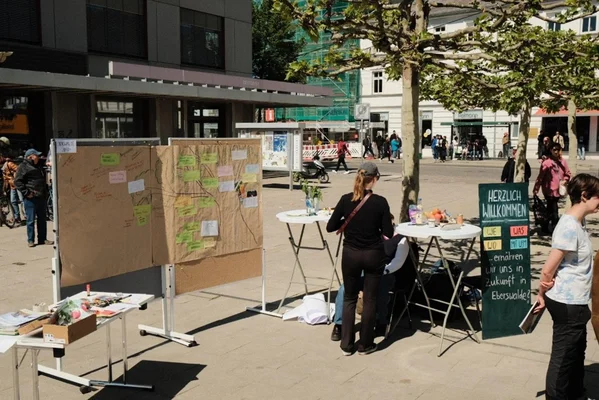
Strengthening students’ own professional profiles is also the aim of the fifth semester, which begins with a twelve-week practical placement for all students and is supplemented by compulsory-election modules and a compulsory module on communication and participation. The latter is designed to present the findings of the ‘Food Systems of the Future’ project module and make them accessible to the public.
You will gain practical insight into a sector of the agricultural and food industry through a work placement with a company or organisation within the food system. You will have the opportunity to reflect on your experiences in relation to sustainable development within the food system and food culture.
You will gain an understanding of, and deepen your knowledge of, the fundamentals of communication and public relations within the food industry. By analysing the findings from the interdisciplinary and transdisciplinary project module ‘Food Cultures of the Future’, you will apply the knowledge you have acquired directly to a real-world example of communication and public relations.
You have a theoretical and practical understanding of quality assessment methods. You possess comprehensive theoretical and practical knowledge of non-destructive and destructive methods (biochemical, physical and instrumental) for determining quality. You understand how integrated quality assessment is applied in production and marketing, and are able to critically evaluate quality control procedures.
You will learn through a simulation exercise that recreates a Conference of the Parties (COP) to an international environmental agreement (UNCCD). You will take on the roles of country representatives. In doing so, you will represent your country’s interests, seek to strike a balance between your own interests and those of the international community, make compromises, but ensure that your country’s minimum objectives are met.
You will acquire the knowledge, skills and competencies needed to design, implement and evaluate effective interventions in the field of sustainable nutrition. The module places particular emphasis on promoting sustainable eating habits among various target groups and imparting knowledge about sustainable food systems and their links to the environment, health and social issues.
In the sixth semester, all the knowledge and experience gained during your studies come together; the aim is to synthesise them. You will produce your practical and conceptual final dissertation, ideally in collaboration with a partner from the industry.
Through your bachelor’s thesis, you will demonstrate your ability to conduct academic research. You will identify a research question relating to a specific sustainability challenge within the food system or food culture and develop potential solutions. You will receive guidance from your supervisors and, where applicable, from industry partners.
In the core module, you will develop your understanding of the fundamentals of interdisciplinary and transdisciplinary collaboration. Depending on your specialisation or the focus of your final research project, you will choose one of the sub-modules a, b or c:
a) Methods of food technology
b) Methods of empirical social research
c) Data analysis & statistics
You view digitalisation as an ongoing task in business management. You are able to independently organise the provision of the necessary data for operational management and implement the internal processes required for this. You understand which operational plans, reports and analyses are necessary and what data is required for these.
You will gain a basic understanding of plant genetics, methods for conserving and utilising genetic diversity, and the legal and ethical aspects of working with plant genetic resources. You will build on your existing skills in sensory analysis and product development by conducting and evaluating sensory tests on selected cereal and vegetable varieties, as well as products developed from them.
Students will be able to assess the potential and current impact of UNESCO biosphere reserves as places of learning and model regions for ecosystem-based sustainable development, and to identify the current management challenges based on selected examples.
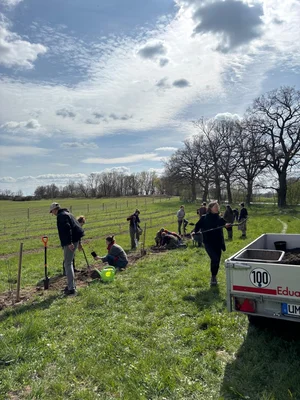
You will learn about agroecological interactions, the political framework and the potential of various agroforestry systems, and will be able to assess and evaluate their practical feasibility. You will understand the relevance of the parameters measured on the agroforestry trial plot and will be able to plan, carry out and evaluate a suitable experimental design.
They understand the history and characteristics of man-made landscapes (using Central Europe as an example). They are able to analyse landscapes, including rural settlements, using maps, geodata and site visits, and to develop maintenance and development plans based on this analysis.
You are able to analyse business models in the agricultural and food sectors. In doing so, you can discuss the impact of changing conditions on these models and develop practical scenarios for their further development.