

A minor sensation in Barnim: HNEE identifies genetically pure wildcats for the first time
As part of a wildlife monitoring programme, students have spotted at least three different wildcats south of Eberswalde – the first genetically confirmed sighting in the Barnim district since the species historically disappeared
After several centuries, the European wildcat (Felis sylvestris) has returned to the Barnim district. As part of the compulsory elective module ‘Wildlife Monitoring’ at the Eberswalde University for Sustainable Development (HNEE), several wildcats were photographed for the first time in a woodland area near Hirschfelde, south of Eberswalde, and subsequently confirmed through genetic analysis. Molecular biological analyses confirm that these are genetically pure wildcats. At least three different animals were identified: two females and one male.
This marks the first genetically confirmed sighting of the European wildcat in the Barnim district since the species disappeared from the area that is now Brandenburg several centuries ago. The discovery is also a further sign of the gradual return of this strictly protected species to its former range.
“This discovery is something of a sensation for us. The fact that we were able to confirm the presence not just of a single migrating animal, but of at least three different wildcats, is an extraordinary result,” says Dr Frank Michler, lecturer in wildlife biology and wildlife management at the HNEE and coordinator of the wildcat monitoring programme. “I am particularly pleased that this success was achieved together with our students. They carried out the monitoring with great enthusiasm, meticulous care and a great deal of personal commitment.”
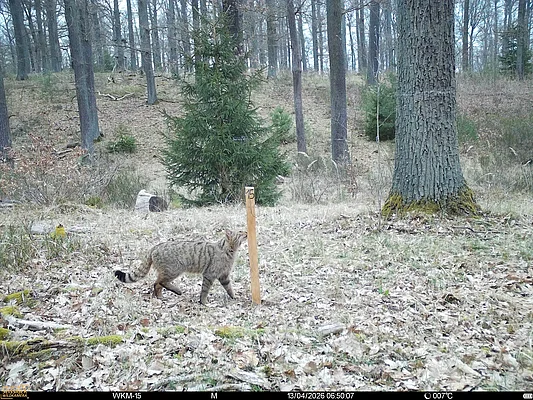
Eine genetisch bestätigte Europäische Wildkatze passiert einen kameraüberwachten Lockstock in einem Waldgebiet bei Hirschfelde.
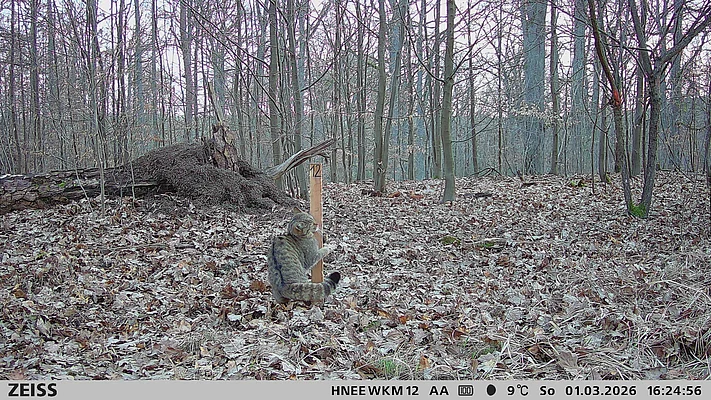
Der Geruch von Baldrian regt die Wildkatze dazu an, sich am angerauten Lockstock zu reiben. Dabei bleiben Haare für die genetische Untersuchung zurück.
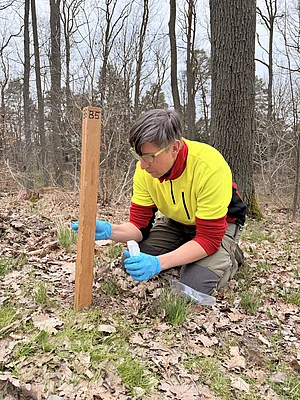
Am Lockstock zurückgebliebene Haare werden sorgfältig entnommen und für die molekulargenetische Untersuchung gesichert.
21 decoy posts and more than 30 hair samples
The wildcat monitoring programme took place from January to April 2026. Together with the students, Michler set out a total of 21 so-called ‘luring posts’ in the Barnim district. The roughened wooden posts were regularly sprayed with valerian tincture. The scent attracts wildcats and encourages them to rub against the stakes. In doing so, hairs are left behind on the wood, which can then be analysed genetically.
Each lure stick was also monitored using a radio-controlled camera trap. As soon as the cameras captured an animal with the typical physical characteristics of a wildcat, the monitoring team was able to visit the site promptly and collect the hair samples in accordance with best practice. The students checked the bait sticks weekly, analysed the camera images, cleaned the sticks and replenished the attractant.
Phenotypic wildcats were documented at a total of nine bait sticks. In total, the team collected more than 30 hair samples. Once the monitoring campaign was complete, these were sent via Jens Teubner from the Species Competence Centre for Mammals at the Brandenburg State Office for the Environment (LfU) in Zippelsförde to the laboratory in Gelnhausen, which specialises in wildlife genetics.
The results of the molecular genetic analyses now available confirm the significance of this discovery: all the samples examined originate from genetically pure European wildcats. Genetic identification allowed at least two female and one male animal to be distinguished.
Applied wildlife conservation as part of teaching
The two-semester elective module ‘Wildlife Monitoring’ was developed by Frank Michler in 2022 and introduced at the HNEE. Since then, 25 students have been starting the module each year in the winter semester. In the module, they learn about various scientific methods for surveying wild animals and apply these directly in the field. The spectrum ranges from monitoring wolves, lynx, wildcats and elk, through the investigation of wildlife crossings, breeding bird monitoring and track analysis, to electrofishing.
“Our aim is to combine scientific teaching, vocational education and concrete species conservation,” explains Michler. “Students do not simply work on purely theoretical exercises, but take part in real, scientifically sound monitoring. The recent evidence of wildcats impressively demonstrates the contribution that practice-oriented university teaching can make to the research and protection of our native wildlife.”
The monitoring programme is carried out on the basis of a cooperation agreement between HNEE and the Brandenburg State Office for the Environment. A key factor in this is the long-standing and close collaboration with Jens Teubner from the LfU’s Mammal Species Competence Centre. Equally crucial is the support of private and state landowners, who enable the monitoring to take place in their forest areas.
Nature-based forest management creates suitable habitat
All genetically confirmed sightings have been recorded in a private forest owned by Mathias Graf von Schwerin near Hirschfelde. The forest area is characterised by nature-oriented management, a high proportion of deadwood, natural mixed forests rich in deciduous trees, and dense, species-rich natural regeneration. It therefore offers particularly suitable living conditions for the wildcat.
Structurally diverse forests provide suitable hunting habitats and offer numerous hiding places and sleeping spots. Deadwood, root plates, tree hollows and areas of dense vegetation also offer undisturbed refuges, which are particularly important for rearing young.
“It therefore comes as no surprise to us that the first wildcats in the Barnim district were recorded in this very forest area,” says Michler. “The nature-friendly forest management practised there for many years has created diverse structures from which not only the wildcat but also numerous other species benefit.”
The wildcat returns to Brandenburg
The European wildcat was originally widespread across large parts of Germany, but was intensively hunted over the centuries and driven out of many regions. Small remnant populations managed to survive in places such as the Harz Mountains. Since the late 1990s, the species has been spreading again at an increasing rate.
The wildcat population in the Harz Mountains is of particular importance for the species’ re-establishment in Brandenburg. The species has now been recorded again, particularly in the south of Brandenburg. There have also been isolated sightings in the north of the state in recent years. The latest sighting in Barnim closes another gap and offers hope that the wildcat is increasingly reaching suitable habitats in north-eastern Brandenburg.
Monitoring of wildcats in the Barnim district is set to continue in the coming years. The aim is to investigate whether the animals are establishing themselves permanently in the region, which areas they use, and whether more wildcats are arriving.