

Forests as health infrastructure
Forests are becoming increasingly important as part of healthcare. At the same time, there is a growing societal need to recognise forests more fully as part of the healthcare infrastructure and to harness them for prevention, health promotion and therapy. Around 35 experts from the fields of forestry, medicine, forest therapy and academia from Brandenburg and neighbouring federal states discussed the potential for forestry, medicine and therapy, as well as the necessary framework conditions, at the workshop ‘Forest-based health interventions – opportunities and challenges for forestry in Brandenburg’ at the Eberswalde University for Sustainable Development (HNEE).
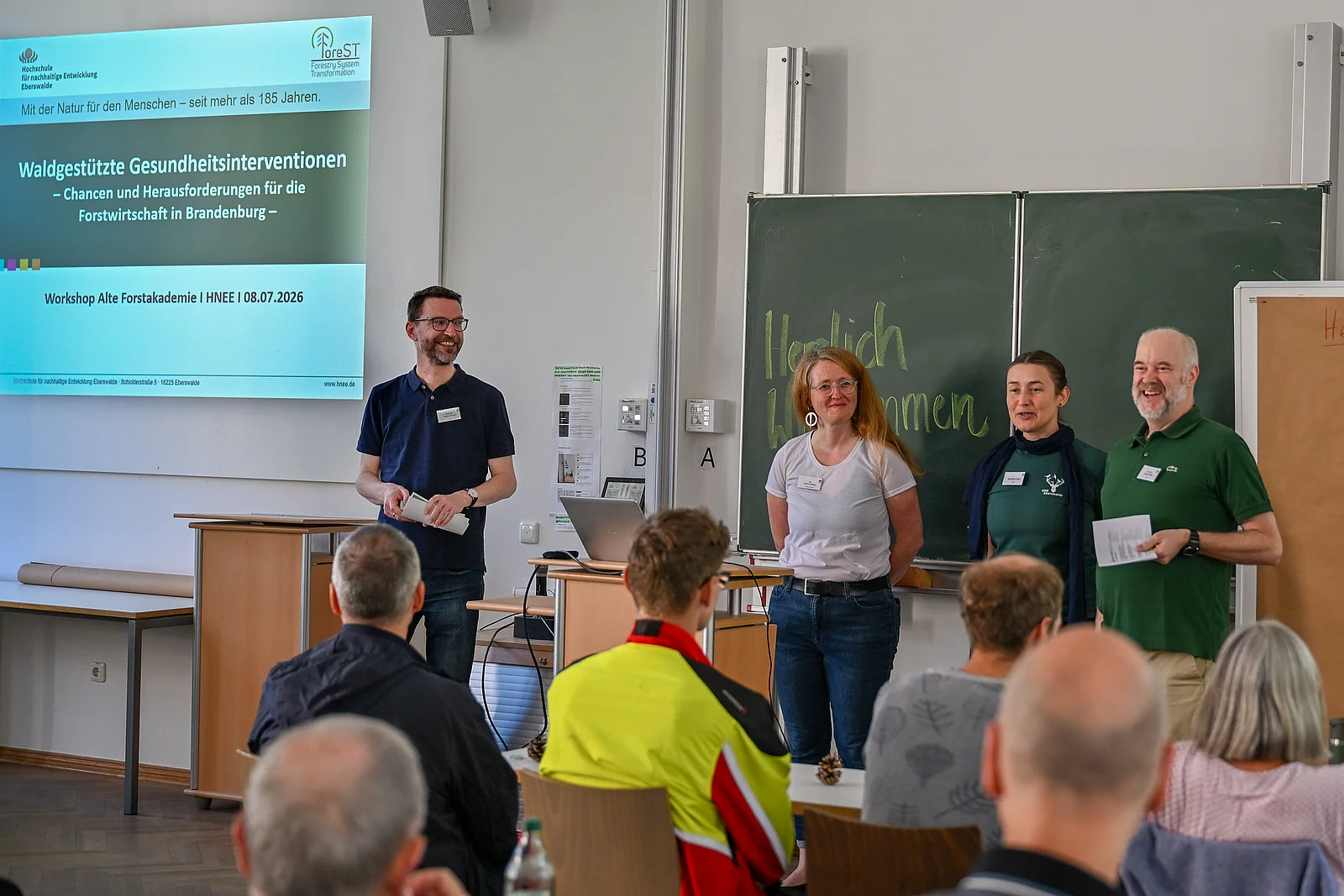
The aim of the joint workshop organised by HNEE and VERDE GESUND was to initiate dialogue between the various specialist disciplines. The aim was to bring together different perspectives on forest-based health interventions and to jointly develop approaches for their future design. Following several keynote presentations from the fields of forestry, medicine and certification, the participants discussed the potential and obstacles to a stronger link between forests and health in moderated working groups. The wide variety of disciplines represented made it clear that forest-based health interventions offer numerous opportunities. At the same time, however, different requirements and interests must also be taken into account.
Among other things, the discussion centred on issues of quality assurance. These related both to professional standards in the training of forest therapists and to the suitability of the forest stands used. Equally intense discussions centred on aspects of the duty of care regarding safety and possible models for profit distribution or profit-sharing for forest owners and forestry operations. The need to view the forest not merely as a resource or backdrop for health programmes was emphasised. Rather, it was stressed that the forest should be understood as an independent partner to be treated responsibly – just as responsibly as one’s own health.
In the afternoon, Dr Kristin Köhler led the participants on a tour of the recently opened health trail in Eberswalde’s municipal forest. The excursion demonstrated how forest-based health interventions can be put into practice and highlighted the requirements in terms of infrastructure, safety and supervision.
A key outcome of the workshop was the realisation
- that the successful further development of forest-based health interventions can only be achieved through close collaboration between the forestry sector, the healthcare sector, academia and other stakeholders, such as health insurance providers.
- At the same time, there is a need for clear framework conditions, reliable partnerships and scientific monitoring of the forest-based health interventions themselves.
The high level of participation and the considerable interest in the topic highlighted the significant potential for new alliances and joint solutions that benefit both human health and sustainable forest management. The future of forest-based health interventions will not be decided solely within the healthcare sector or the forestry sector. Rather, it will emerge at the interface between the two systems – through shared quality standards, scientific evidence and new partnerships.
The workshop thus marked an important starting point for further interdisciplinary exchange and demonstrated that Brandenburg offers favourable conditions for shaping the future of forest-based health interventions collaboratively and responsibly.