

Prof. Dr. Alexander Conrad
Professor of Economics specialising in regional economics, Head of Undergraduate School, Head of Sustainable Economics and Management Programme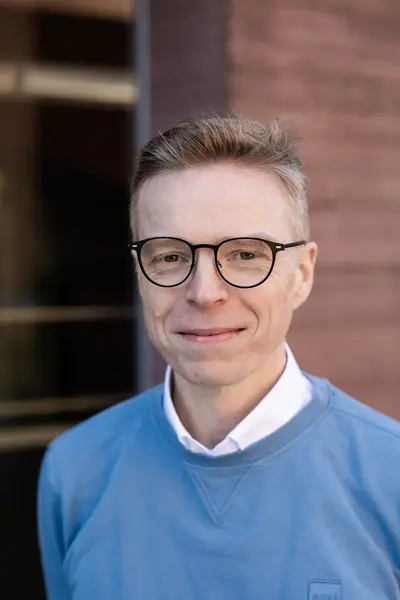
| Alexander.Conrad(at)hnee.de | |
| Phone | +49 3334 657-289 |
| Location | Forest Campus | Alfred-Möller-Straße 1 | 16225 Eberswalde |
| Room | 12.102 |
| Office Hours | Request appointments by email! |
| Website | Head of Undergraduate School |
- Economics (micro, macro)
- Regional economics and regional development
- Quantitative methods / econometrics
- Fundamentals of public activities, municipal economics
- Financing and investment
- Plural economy
- Sustainable and innovative supply systems (services, infrastructure) in rural areas
- Impact of demographic change on the situation of regionally based actors (local authorities, regional banks, SMEs, etc.)
- Instruments for sustainable regional development
Establishment of Forum N
Cooperation with Sparkasse Barnim and the East German Savings Banks Association to develop a student-led forum N to promote research and transfer on topics such as sustainable regional finance and sustainable regional development.
GENOTRAFO – Cooperatives as key players in socio-ecological transformation
The project ‘Cooperatives as key players in socio-ecological transformation’ (GENOTRAFO) focuses on the socio-ecological potential of cooperatives, especially in rural areas where many small and medium-sized enterprises (SMEs) face the challenge of finding suitable employees and successors. If, for example, the village bakery or country inn cannot find a successor, employees could continue to run it as a cooperative, as a team rather than a single person.
Ensuring start-ups and successions is essential for stabilising economic structures in peripheral regions and preserving jobs. This is precisely where GENOTRAFO comes in, working closely with stakeholders from business, research and civil society. Cooperative models for start-ups and business successions are scientifically investigated and practical solutions are developed together with cooperation partners.
iLab – Institutionalisation Laboratory Region 4.0
At the conclusion of the WIR! Alliance Region 4.0, the consolidation and institutionalisation of structures, results, networks, etc. is to be promoted from a strategic and scientific perspective. The iLab (1) reviews the results of the alliance's work to date, (2) identifies starting points for consolidation and (3) develops transfer formats for this purpose, which are tested on a trial basis with relevant actors in the Uckermark implementation region and beyond.
region 4.0 – WIR! alliance and innovation network in BAR-UM
The Region 4.0 alliance is backed by a large number of partners from the fields of research and business. Since 2018, these partners have been engaged in intensive dialogue with regional stakeholders, citizens and individual initiatives in order to promote the development of a culture of innovation in the region.
Regional Innovation Management RIM
Development and spin-off of a regional innovation management system for the Uckermark-Barnim-Altkreis-Ueckerrandow region. Spin-off as AngerWERK (www.angerwerk.de). Funded by the Federal Ministry of Education and Research (BMBF).
soLo – Social Logistics / UckerWarentakt
Development and testing of social logistics in the Uckermark region as an extension of regional supply structures. Transfer of the approach as UckerWarentakt into the public transport structures in the Uckermark region.
Inno4Ufo – Innovative tools for business succession
Project to develop co-creative support services to increase the likelihood of successful business succession. Support for companies in the business succession process. Funded by the Federal Ministry of Education and Research (BMBF).
Physical and digital accessibility of financial services
Development and testing of new indicators for determining and evaluating the regional provision of financial services. Determination of the digital divide in terms of access to and use of digital offerings from financial service providers. Funded by the Sparkassen-Finanzgruppe's science promotion programme.
FutureLab
Development and testing of approaches to career and study orientation to reduce dropout rates in training and higher education. Implementation and evaluation of annual work camps for young people and establishment of networks or support for networks in the field of securing skilled labour. Funded by the EU.
Head of Bachelor's Programme in Sustainable Economics and Management
Head of Undergraduate School
Deputy Head of Undergraduate School
Research professorship with a focus on transfer
Coordinator of the WIR! Innovation Alliance Region 4.0
Vice-Dean (dual leadership of the Dean's Office) of the Department of Sustainable Economics
Deputy Vice-Dean of the Department of Sustainable Economics
Head of the Regional Management programme
Professor of Economics, specialising in regional economics at HNEE
Consultant and project manager for demography, innovation management, strategy and special tasks at the East German Savings Banks Association, Berlin
Doctorate in political science under Prof. Dr. Doris Neuberger at the Chair of Money and Credit at the University of Rostock, Institute of Economics,
Topic: Banking in shrinking regions – Effects of ageing and migration on regional banks, with particular reference to savings banks
Project and research assistant at the University of Rostock, Institute of Economics, various chairs
Doctoral scholarship from the Sparkassen-Finanzgruppe's science promotion programme
Studied economics at the University of Rostock
Training as a bank clerk at Sparkasse Uckermark
Chair of the Budget Committee of the HNEE
Member of the HNEE Research Commission
Member of the Senate of HNEE
Member of the Faculty Council of the Faculty of Sustainable Economics
Chair of the Examination Board for part-time degree programmes
Analysing micrologistics initiatives in rural areas – Approaches to typologise and assess complex logistics solutions in regional supply networks
mit Susanne Hofmann-Souki, Annemarie Wojtech und Martina Schäfer, Journal of Rural Studies, 110(1): 103348
DOI: 10.1016/j.jrurstud.2024.103348.
Unternehmensnachfolgemonitoring Uckermark - Ermittlung von Bedarfen, Potenzialen und regionalökonomischen Risiken
mit Sophia Krebber und Yvon Pieczynski.
Evaluation des Instruments Raumstipendium - Bewertung der Zielerreichung und Wirkung nach einem Jahr Anwendung
DOI: 10.13140/RG.2.2.21030.40006.
Social logistics: Rethinking public transport as a regional distributor of goods in rural areas. Chances for the long-term establishment of a sustainable regional logistics approach
mit Eva Greischel, Emilia Nagy und Martina Schäfer, Raumforschung und Raumordnung, Spatial Research and Planning 82(2)
DOI: 10.14512/rur.1690.
Der UCKER Warentakt als Ansatz einer sozialen Logistik - Impulse für Umsetzung und Weiterentwicklung - Eine Handreichung basierend auf Ergebnissen aus dem Projekt „Soziale Logistik“ des WIR!-Innovationsbündnisses region 4.0
mit Eva Greischel und Jan Lindenberg, DOI: 10.13140/RG.2.2.22756.14720.
Diese Region ist versorgt? - Messansätze zur Beurteilung der regionalen Versorgung mit hausärztlichen Angeboten auf dem Prüfstand
mit Fabian Rösch und Christiane Villain, 3. Brandenburger Kongress für Versorgungsforschung.
Der Mensch im globalen Ökosystem, Eine Einführung in die nachhaltige Entwicklung
mit Pierre L. Ibisch, Heike Molitor, Heike Walk, Juliane Geyer und Vanja Mihotovic, Oekom Verlag, 2. Auflage.
Crowdlogistik im ländlichen Raum - Ergebnisse einer Innovationsbarrieren-Ausprägungs-und -Bewältigungsanalyse
mit Fabian Rösch, DOI: 10.13140/RG.2.2.25670.14407.
Nutzung und Nutzen wohnortnaher Paketdepots im ländlichen Raum als Teil einer smarten Logistik - Modellierung und erste Empirie
DOI: 10.13140/RG.2.2.14100.78726.