Reuse and Recycling Index for Waste Timber for Value-Preserving Reuse
Research project
11/2021 - 03/2025
Project volume:329.952 EURO
Competence field:Wood as a raw material
Cooperation:Practical partnership
Funding partner:State funding
Department:FG Chemie und Physik des Holzes
The collaborative project “WIn-Altholz” focused on promoting the highest possible quality of material reuse for waste timber. In particular, for waste timber fractions consisting of solid timber, the project sought to establish key prerequisites and identify alternative recycling pathways while preserving dimensions and form to the greatest possible extent.
To this end, a portable scanner was developed for on-site use, for example at recycling centres or prior to deconstruction work, and the necessary database was established to enable more accurate classification into waste timber categories A I or A II–A IV. In addition, an index was developed to assess solid waste timber based on its specific characteristics and assign it to potential material reuse pathways of the highest possible quality. Research was also undertaken into the development of a composite material (Reclaimed Wood Plastic Composite, or RPC) to enable waste timber previously unsuitable for material reuse (Category A IV) to be recycled within a safe matrix that encapsulates harmful substances.
The scanner development resulted in an NIR-based prototype for rapid surface-based detection, which makes the sorting of waste timber more objective and improves it compared with the previous visual sorting method. Its basic functionality was demonstrated in both laboratory and field tests. There is currently still scope for optimisation, particularly with regard to the detection rate of approximately 75 per cent. Due to changes to the project plan following the insolvency-related withdrawal of a project partner, the discriminant models developed could not be optimised to the desired extent.
As a prerequisite for the scanner’s detection capabilities, a comprehensive database of test specimens and spectra was established that is unique in its form. This provides an excellent basis for further improving the scanner’s chemometric detection and assessment capabilities, as well as for future developments aimed at optimising waste timber sorting.
An index was also developed to assess solid waste timber according to its specific characteristics, including dimensions, contaminants and quality characteristics, and to assign it to potential reuse pathways of the highest possible quality. The aim was to retain the material’s value as a secondary raw material within the material cycle. To ensure practical applicability, the index was translated into a mobile-friendly clickable wireframe.
Investigations into the RPC’s abrasion resistance, resistance to artificial weathering and durability against wood-destroying fungi contributed to the characterisation of its material properties.
Project lead:
Prof. Dr.-Ing. Alexander Pfriem
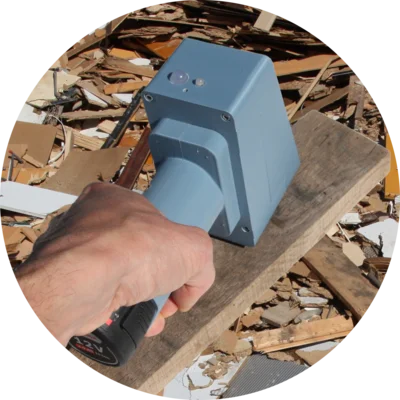
The scanner determines which waste timber category the remaining piece belongs to.
Contact
General contact
Christian MüllerResearch assistant
Project manager
Prof. Dr.-Ing. Alexander PfriemProfessur für Chemie und Physik des Holzes sowie chemische Verfahrenstechnik
Funding partner
Federal funding
Partnerships
Network





Practice partnerships