Personalised course content
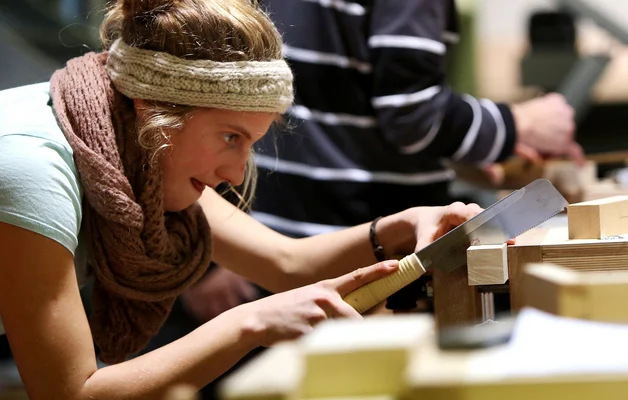
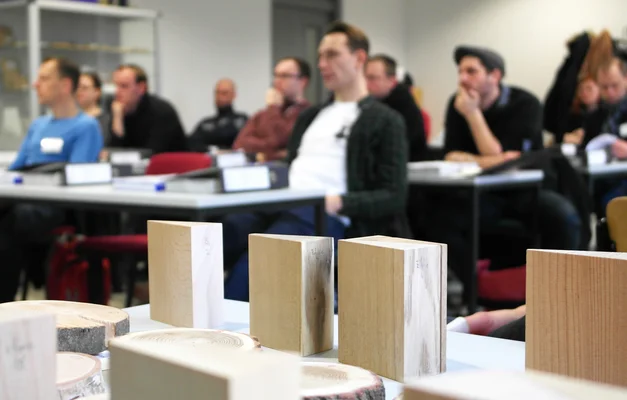
During the first three semesters, you will acquire a foundation in natural sciences, engineering and wood technology through lectures, seminars, practical sessions and field trips.
In the fourth semester, you will choose one of the two specialisations: Structural Engineering or Wood Technology. You can further specialise through optional modules.
In the sixth semester, you will undertake a 20-week placement, which can be completed either in Germany or abroad.
Following further specialisation modules, you will complete your studies in the seventh semester with a Bachelor’s thesis and be awarded the degree of Bachelor of Engineering (B.Eng.).
Modules per term
In the first semester, you will build on the maths and science skills you acquired at school and learn the basics of timber engineering in the STEM subjects, as well as timber processing and working. A particular highlight is a course on sustainable development, which is attended by students from all degree programmes.
You will use mathematical tools to model real-world problems in structural analysis and strength of materials, and present the results. Familiar with mathematical and physical methods and ways of thinking, you will apply these in other core subjects and advanced courses. You will understand scientific methods and ways of thinking as the foundation of all engineering practice.
You will learn to classify the fundamentals of machining wood and wood-based materials, as well as key terms in manufacturing technology, and to understand process models for machining. You will be familiar with cutting materials and their applications, as well as the processes involved when a cutting edge engages with wood. You will be familiar with the machinery and equipment used to produce geometrically defined products from wood and wood-based materials.
In this module, you will gain a basic understanding of wood biology and acquire fundamental botanical knowledge. In addition to a basic understanding of wood biology, you will be able to use tools for identifying wood species and distinguish between different types of wood defects. With knowledge of forestry practices, you will be able to explain secondary forestry uses. You will become familiar with specialist press and literature.
This module teaches you the basics of technical drawing, computer-aided design and the modelling of components and assemblies. You will use computers to calculate technical relationships and produce technical documentation. You will link sample workflows to create simple programmes. You will also have acquired knowledge of geometric design and data processing.
You will gain an understanding of sustainable development, particularly in relation to raw materials and resources. Through an interdisciplinary, integrated theoretical examination of the concept of ‘sustainable development’, you will be able to apply this knowledge to real-world examples. You will be able to identify raw materials and their sources, and assess their extraction in terms of its environmental impact.
In the second semester, you will build on the fundamentals. In addition to further study in mathematics, technology and the natural sciences, you will be introduced to business management.
You will gain a deeper understanding of the fundamentals of strength of materials and the relevant mathematical tools. You will be familiar with analytical methods in dynamics (kinematics and kinetics). You will be able to solve engineering problems and understand the physical mechanisms at work in dynamic and fluid systems. You will be able to assess and evaluate the structural properties of wood as a raw material.
You will learn about the engineering requirements for a joint. In terms of theory, we will cover the design of joined timber components and hybrid components. You will apply current standards for load-bearing and non-load-bearing bonded joints and master the scientific and engineering methods used to design a bonded joint. The theoretical content is reinforced through accompanying practical sessions.
In this module, you will gain a basic understanding of wood chemistry and wood preservation, chemistry in engineering, the chemical composition of wood, the chemical properties of wood, and the limitations of wood’s use. You will understand the relationship between the structure of wood components and their function, learn about wood-destroying fungi and insects, and become familiar with the basic measures of wood preservation.
With a basic understanding of mechanical engineering and the science of metallic materials, you will understand the relationships between materials, machine components and design. During the design process, you will apply this knowledge to simple mechanical engineering components in accordance with relevant standards. You will become familiar with prototype production, the launch of series production, and maintenance and repair work. You will be able to formulate design requirements for complex mechanical engineering problems.
We will provide you with a basic understanding of the principles of economic activity. You will learn to apply business concepts in a practical way, linking them to the content and objectives of the sustainability framework, and gain an understanding of fundamental corporate structures, processes and decision-making.
In the third and final semester of the foundation phase, further aspects of engineering in general and timber engineering in particular are covered. An introduction to structural engineering provides students with the basic principles of building construction.
You will now learn the basics of electrical engineering and use mathematical methods to solve electrical engineering problems. You will understand electrical and electronic applications in mechanical and timber construction and be able to classify electrical systems. Working alongside an electrical engineering specialist, you will be able to analyse systems, develop approaches to specific circuit design tasks and organise work tailored to specific requirements.
You will acquire the physical and technical knowledge required for fundamental manufacturing processes. This includes learning about the mechanical and thermal principles involved in the production of solid wood products.
Upon completion of this module, you will be able to categorise and name manufacturing processes, and plan, operate and evaluate machine tools professionally.
This module covers the fundamentals of wood physics and chemistry, as well as wood pyrolysis. You will learn about the key physical properties of wood. You will be familiar with the physical properties of wood, be able to assess the appropriate use of wood in accordance with standards, and have knowledge of the pyrolysis, combustion and gasification of wood. You will be able to apply the relevant regulations and standards relating to wood technology and physics.
You apply in-depth knowledge of the fundamentals of mechanical engineering to the design and analysis of machinery and plant, and are able to design welded structures. You calculate stresses and strains in complex components and can estimate their service life. You evaluate the dynamic behaviour of machinery and optimise designs to meet specific requirements.
Our aim is to provide you with a basic understanding of building structures, architectural design, building materials and common construction methods in structural engineering (foundations, steel construction, reinforced concrete and masonry construction). Furthermore, we will equip you with the skills to produce a design for a building.
The specialisation phase of your degree begins in the fourth semester. Depending on your chosen specialisation, you will now take specialist modules. You can further tailor your studies by selecting compulsory-elective modules from the field of timber engineering or other courses offered by HNEE or other universities.
You will analyse mechatronic systems using principles from engineering, electrical engineering and mechanical engineering, supplemented by mechatronics and engineering mathematics. You will be able to design and build simple systems. You will have practical skills, be confident in using laboratory and measuring equipment, and be able to analyse data using appropriate statistical methods.
We teach the fundamentals of building design, work together to analyse partial and overall concepts within the design process, apply optimisation strategies for harnessing solar gain, summer heat protection and thermal comfort, understand the requirements and optimisation potential of a building’s thermal envelope, and develop concepts for the energy supply of buildings.
You will study the fundamentals of mechanical process engineering. This includes understanding the technical implementation of physical effects and interactions on particles with mass, as well as calculating performance and monitoring material conversion plants. You will gain an insight into the various basic operations of mechanical process engineering.
Drawing on knowledge of the anatomical and structural differences between wood species, links are established with process engineering and various process variants are examined. Students classify raw materials according to their quality and determine their appropriate uses in production. This is followed by instruction in methods for structuring the manufacturing process. For the timber industry, students learn about aspects of process control and are taught quality criteria.
In this module, you will learn the fundamentals of building design, analyse partial and overall concepts within the design process, and apply optimisation strategies relating to the utilisation of solar gain, summer heat protection and thermal comfort. Furthermore, this module focuses on teaching the requirements and optimisation possibilities for the thermal envelope of buildings, supplemented by the development of concepts for the energy supply of buildings.
- CNC 1
- Furniture and Interior Fitting/Construction
- Alternative manufacturing processes
- Timber Construction Fundamentals of Wood Technology
- Properties of timber and timber-based materials relevant to construction
- Manufacturing and processes for building components and elements
- Sustainable construction, material cycles 1 (specialisation in building construction)
- Integrated timber preservation (specialisation in building construction)
- Wood treatment (specialisation in wood technology)
- Specialised materials science (specialisation in wood technology)
In the fifth semester, you will continue to specialise. A key feature of this semester is the engineering project, in which you will work in groups to tackle an engineering problem and document your findings in accordance with academic standards.
You will carry out independent academic research and be able to present your findings in English. As part of a practice-oriented project, you will organise and manage the work yourself, gaining experience in self-management. The engineering project serves as a preparatory exercise for the final dissertation; it is to be completed in groups of three students and is supervised and guided.
We teach you to understand the context of building regulations, select basic structural designs and details for building components, and develop components and connections that meet the relevant requirements. You will identify smoke management options and calculate component specifications based on model fire tests in accordance with the IndBauRL. You will document the material requirements of the architectural design and draw up preliminary fire safety concepts.
You will be able to design and calculate simple timber structures involving joints and connections, gain an understanding of repair joints used in renovation work, acquire knowledge of typical construction methods in timber construction and the use of design software, and be able to understand and evaluate the calculations and designs produced by other designers.
You are familiar with the fundamentals of design theory relating to sustainability and can develop design requirements for energy-efficient, sustainable buildings. You are familiar with assessing the requirements of energy-efficient, carbon-neutral construction methods, are knowledgeable about energy balancing methods, and can evaluate and optimise construction methods as well as key parameters relating to thermal building physics and building climate.
The focus is on structuring, designing and planning development processes in both interior fit-out and timber construction. Participants will learn the design aspects of product development; we also teach skills in communicating with team members and external parties, as well as presentation techniques tailored to different audiences.
We present the fundamentals of processing wood and lignocellulosic plants into sheet-like materials in the manufacture of chipboard and fibreboard – including the preparation of wood raw materials into particles, as well as mixing and agglomeration processes. Assignments and experiments in the laboratory of the Fraunhofer Institute for Wood Research provide a deeper understanding of the subject matter.
-
Business English
-
Production Planning
-
CNC 2
-
Marketing
-
Specialised Wood Biology
-
Specialisation module
-
Quality assurance
-
Building physics measurement technology
-
Fire protection
-
Raw timber quality
-
Sawn timber grading
-
Selected chapters Wood-based materials technology
-
Wood in construction
-
Automation technology
-
Factory planning
In the sixth semester, you will undertake a 20-week placement, during which you will be able to apply and further develop the knowledge you have acquired so far. The placement can be undertaken either in the UK or abroad.
During the practical semester, you will prepare for your future career through engineering-related activities and practical content, applying the theoretical knowledge and skills you have acquired. You will also prepare for a leadership role involving economic and social responsibility.
.
After completing further modules, you will conclude your degree in the seventh semester with your Bachelor’s thesis. You will undertake research on an engineering topic and present your findings in an academic report. Upon successfully defending your thesis, you will complete your degree and be awarded the title of Bachelor of Engineering.
In the Business Management module, you will learn the fundamentals of commercial law as well as human resources and business management. You will also gain a basic understanding of construction and public procurement law. By developing a fundamental understanding of the organisational structure and operational processes in manufacturing companies, you will design operational value chains and learn how to make effective use of management tools.
We enable you to design new timber structures and carry out structural calculations in accordance with current standards.
This module demonstrates the interactions between materials and process factors, using veneer production as an example. The impact of chemical and physical process variables on product quality is explained through examples such as plasticisation, the cutting process, drying, etc. This includes learning to consider different approaches to achieve technological objectives.
- Business English
- Production Planning
- CNC 2
- Marketing
- Specialised Wood Biology
- Specialisation module: Quality Assurance
- Building Components (Specialisation in Building Construction)
- Sustainable Construction – Material Cycles 2 (specialisation in Building Construction)
- Building physics measurement technology
- Fire Protection (Specialisation in Wood Technology)
- Raw timber quality
- Sawn timber grading
- Selected chapters in wood-based materials technology (specialisation in wood technology)
- Wood in construction
- Automation technology
- Factory planning
Your final project marks the completion of the engineering-focused, work-oriented part of your training. Through this project, you will apply your theoretical knowledge and work on a practical assignment over a 12-week period. You will use scientific methods to develop efficient, practical solutions. In doing so, you will gain further experience in self-management.