

Personalised course content
Through the dynamic INES network (→ Innovation Centre for Sustainable Food Systems), which combines practice, teaching and research, the programme offers you the ideal conditions for linking theoretical content with practical application – right from the start of your studies.
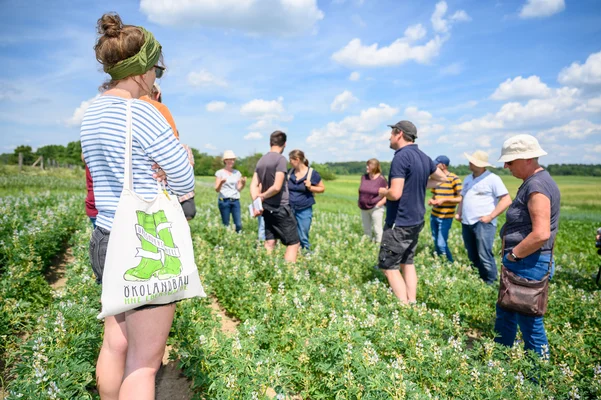
In the first two semesters, we focus exclusively on the fundamentals – both in the lecture theatre and out in the field. Following this academic preparation and an orientation workshop, you will begin your practical semester (practical phase).
In the fifth semester, you will choose one of the three specialisations on offer: Plant Production, Animal Production or Sustainable Agri-Food Systems.
The programme consists of 6 semesters. You can earn 30 ECTS credits per semester, totalling 180 ECTS credits for the entire Bachelor’s programme.
(copy 1)
Modules per term
In the first semester, you will learn the theoretical foundations of biology, economics, location factors and academic research. You will also study the principles of sustainability as part of an interdisciplinary module.
You will acquire a basic understanding of the biology of crops and livestock. This module covers the fundamentals of ethology, anatomy and physiology relating to livestock, as well as their importance in maintaining good health.
The module covers the history, developmental stages and current challenges of organic farming. We want you to develop a systemic understanding of sustainability.
In addition to the basics of economics, this module places the agricultural and food industry within the broader context of the economy. The course in farm management will equip you to tackle decision-making processes at the farm level and apply planning tools.
A basic understanding of the site factors – soil, hydrology, geology, geomorphology and climate – will enable you to assess sites in terms of soil fertility. You will learn about the nutritional requirements of plants in organic farming and the resulting interactions.
We will teach you key research methods and their interdisciplinary application, as well as how to organise work processes for collaborative research projects. This also includes the basics of statistics.
In the second semester, you will acquire more specialised knowledge in marketing, arable and horticultural farming, and livestock production. You will combine practical experience gained at a partner farm with the theoretical knowledge you have learnt, gaining an in-depth insight into the real-world working and living environments of the organic agriculture and food industry in Berlin and Brandenburg.
This module focuses on the development and implementation of strategic and operational marketing decisions by stakeholders in the agri-food sector.
They learn about the structure, function and criteria for the use of machinery and equipment, as well as how to evaluate them from a technical perspective.
This includes assessing grassland stands from a forage production perspective based on species composition and deriving management measures.
This module covers specialist knowledge of animal breeding and husbandry, as well as the planning and evaluation of housing systems for farm animals. You will also learn about breeds and breeding methods used in organic farming.
Through a problem- and action-oriented learning approach, you will gain access to a project run by the industry partner. When it comes to finding solutions, the development of technical skills is just as important as social and personal skills.
You will acquire your knowledge independently, actively and on your own initiative. At the same time, you will gain initial practical experience in the businesses.
This video provides an insight into the project. The module was awarded the Ars Legendi Prize under its former name, “Project Study Partner Organic Farm”.
The third semester is designed to help you build on your foundational knowledge of animal and plant production. In addition, you will explore topics relating to agricultural and food policy, accounting and financial management.
You will be introduced to the assessment and planning of feeding regimes for cattle, pigs and chickens. The focus is on cattle.
This module covers the assessment of crop production systems (arable and grassland systems), the classification of crop types and their requirements, as well as yield and quality parameters. You will independently develop solutions to problems arising in the various crop-specific cultivation methods.
The module focuses on assessing the impacts of current developments in agricultural, food, nutrition and environmental policy from the perspectives of individual farms, regions, sectors and the economy as a whole.
You will learn about internal and external accounting systems, agricultural bookkeeping and balance sheet analysis. The fundamentals of financial mathematics and the application of financial planning tools will become part of your toolkit.
Having completed the theoretical preparation from your foundation year and an orientation workshop, you will begin your practical semester in the fourth semester (practical phase).
During the practical phase, you will gain an insight into the workings of organic farming and the food industry. The focus is on the practical application and consolidation of the knowledge and skills you have previously acquired during your studies. Above all, you will carry out practical work under qualified supervision in accordance with a jointly agreed training framework and analyse this work.
This includes insights into the circular economy, processes in crop production and livestock farming, the processing and marketing of products, and quality assurance in organic farming.
In the fifth semester, you will choose one of the three specialisations on offer: Crop Production, Livestock Production or Sustainable Agriculture and Food Systems.
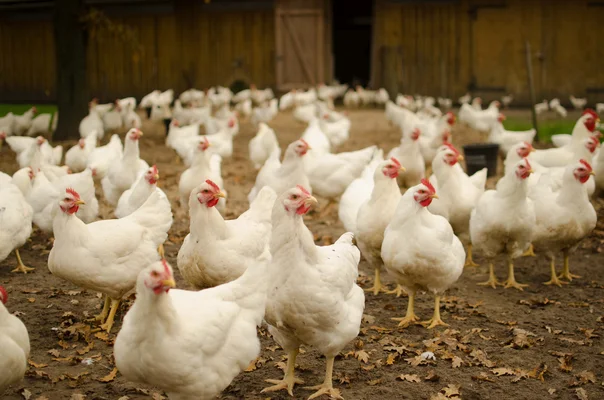
In the Animal Production specialisation, you will gain in-depth knowledge of the husbandry and health of the main livestock species – cattle, pigs and chickens – as well as other animal species such as small ruminants (goats and sheep) and poultry such as geese. Current challenges facing animal husbandry, such as climate change, environmental protection and improving animal welfare, as well as current social debates regarding the role of animal husbandry in society, are also covered in this specialisation.
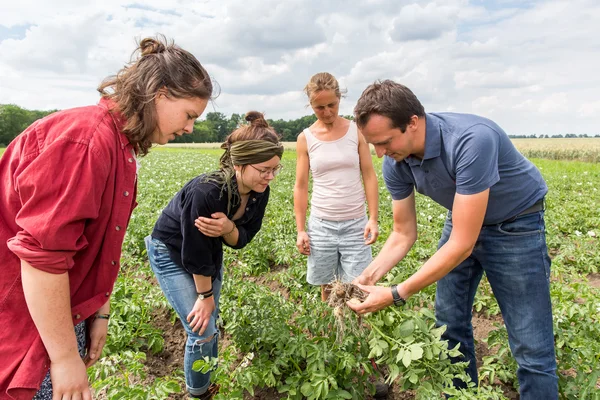
In the Plant Production specialisation, you will acquire in-depth expertise in analysing current practical issues in crop production (e.g. the planning, design and evaluation of field trials for testing new crops, varieties and fertilisation methods). You will expand your specialist knowledge of organic vegetable production and specialised crops. The integration of crop production methods into the agroecological context plays a key role. Current challenges, such as adapting cropping systems to the effects of climate change or promoting biodiversity through the application of specific nature conservation measures, are also addressed.
In the specialisation in Sustainable Agriculture and Food Systems, you will acquire in-depth expertise in analysing business models within the agricultural and food sectors, taking into account key sustainability-related issues, as well as the operating environments and framework conditions of typical business models and value chains in these sectors. You will expand your skills in the economic evaluation of selected agricultural production methods and sectors of animal and plant production, as well as quality assurance within food value chains. Current sustainability challenges in the food system and approaches to addressing them form the basis of this specialisation.
In preparation for your final research project, you will learn the basic steps involved in planning, conducting and analysing (field) experiments and empirical social research. These will be applied to your own and current research questions as examples.
You will collect data on the agroforestry trial plot, plan and carry out an experimental design, and analyse the results. In doing so, you will gain an understanding of agroecological interactions, the political framework and the potential of various agroforestry systems.
They are responsible for the conceptual development, preparation and practical implementation of a field trial addressing current issues in organic arable farming, horticulture and forage production.
We will show you how working horses can be used in arable farming and market gardening, grassland management, forestry and landscape conservation. You will receive basic information on training both the horse and the owner, on husbandry and feeding, and on how to integrate the use of working horses within a sustainable framework.
In this module, you will gain an understanding of digitalisation as an ongoing task in business management. This covers operational planning, reports and analyses, as well as the necessary data. Through a practical example of IT-supported data provision, you will gain an insight into digitalised business management and process design.
In this intensive seminar, we will work with you to address key issues and topics relating to starting a business in the agricultural and food sectors, and we will look at how to plan the steps involved in business start-up and succession processes.
This module focuses on selected operational issues in agriculture and horticulture relating to the redesign, further development or adaptation of agricultural techniques. This includes detailed planning and the evaluation of outdoor and indoor techniques, as well as the use of machinery, equipment and tools.
You will examine the requirements for the registration and licensing of a food business. In doing so, you will learn about the responsibilities of a person in charge of food processing. This includes the facilities and processes involved in the production of food of plant and animal origin, as well as the design of quality assurance measures.
In this module, we will discuss the assessment of ecosystem services (ES) – such as agricultural production, climate protection and the conservation of genetic resources – using relevant tools in practical settings, as well as the analysis of conflicting objectives and opportunities for development aimed at optimising these ecosystem services.
This module enables you to explore the potential of agriculture to deliver social benefits in the areas of health, inclusion, employment, education and therapy. You will work on planning and implementation in collaboration with other social services within the agricultural sector.
Various less commonly kept animal species are considered as potential alternative sources of income in agriculture, and you will learn to evaluate the relevant areas of farming in a comparative manner. You will have a basic understanding of breeding, husbandry and feeding for each species, which you will apply in practical exercises.
This module focuses on production-related diseases in cattle, pigs and chickens, including their symptoms and causes, as well as the development of preventive measures.
You will apply business management tools and apply management, organisational and coordination approaches to operational situations. In this module, you will also learn how to assess cross-organisational collaborations and value chains within the organic agri-food sector.
You will develop your chosen specialisation in greater depth. To this end, you will select three compulsory-elective modules associated with the specialisation during the course of your studies. The final dissertation in the sixth semester will be tailored to the theme of your specialisation.
You will analyse business models in the agricultural and food sectors and examine how changing conditions affect them. In this module, you will develop practical scenarios for further development.
We provide an overview of the main types of vegetables and their growing requirements. The content includes an overview of the characteristics of field vegetable cultivation, greenhouse cultivation and seedling production, as well as a comparison of different cultivation methods. You will identify appropriate measures for different crop types and learn the principles of proper harvesting and storage for key vegetable varieties.
You will learn about business valuation and the analysis of selected agricultural sectors and production processes in crop and livestock production. This also includes the application of cost-performance accounting tools (e.g. contribution margin analysis, sector-by-sector accounting).
Through a project-based and research-oriented approach to learning, you will be able to independently analyse industry-specific business processes and marketing trends. You will also be able to carry out practical business planning and develop marketing strategies. This is done in groups in collaboration with business managers and specialist lecturers.
Here, you can consolidate and apply the knowledge gained in the core modules using case studies from farms specialising in breeding, husbandry and feeding. This also includes the analysis and planning of farm operations.
In this module, we will examine the survey of grassland stands and their assessment according to agricultural and conservation criteria, taking into account development objectives for the stands. We will then derive appropriate management recommendations.
We are exploring ways to utilise renewable energy sources on farms. In doing so, we take into account current renewable energy sources and their conversion pathways for energy and material use, and examine the potential for using renewable raw materials for both energy and material purposes.