

Strengthening scientific cooperation between Japan and Eberswalde
High-tech innovation and centuries-old traditions, vibrant cities and surprising tranquillity: Japan captivates with its contrasts. Despite all the cultural differences, there are many similarities – particularly when it comes to the scientific issues and challenges facing universities in both countries.
At the end of October 2026, a delegation from HNEE travelled to Japan to strengthen existing university partnerships and explore new opportunities for collaboration. Accompanied by HNEE President Prof. Dr Matthias Barth and Prof. Dr Luis Carlos Miranda, the Centre for International Affairs (CIA) visited five universities: the Tokyo University of Agriculture and Technology (TUAT), Akita International University (AIU), Akita Prefectural University (APU), the University of Tokyo and Kanazawa University.
In addition to student and staff exchanges, the discussions focused on shared perspectives on research, knowledge transfer and teaching. Topics also included common academic questions, diverse and complementary research approaches, as well as opportunities to develop joint projects and integrate new findings into teaching.
The visits to Tokyo, Akita and Kanazawa provided a wide range of insights into research approaches, teaching concepts and forms of knowledge transfer. They highlighted new prospects for collaboration, but also made it clear which issues and challenges still need to be addressed.
Tokyo University of Agriculture and Technology – Where research meets practice
(Kopie 1)
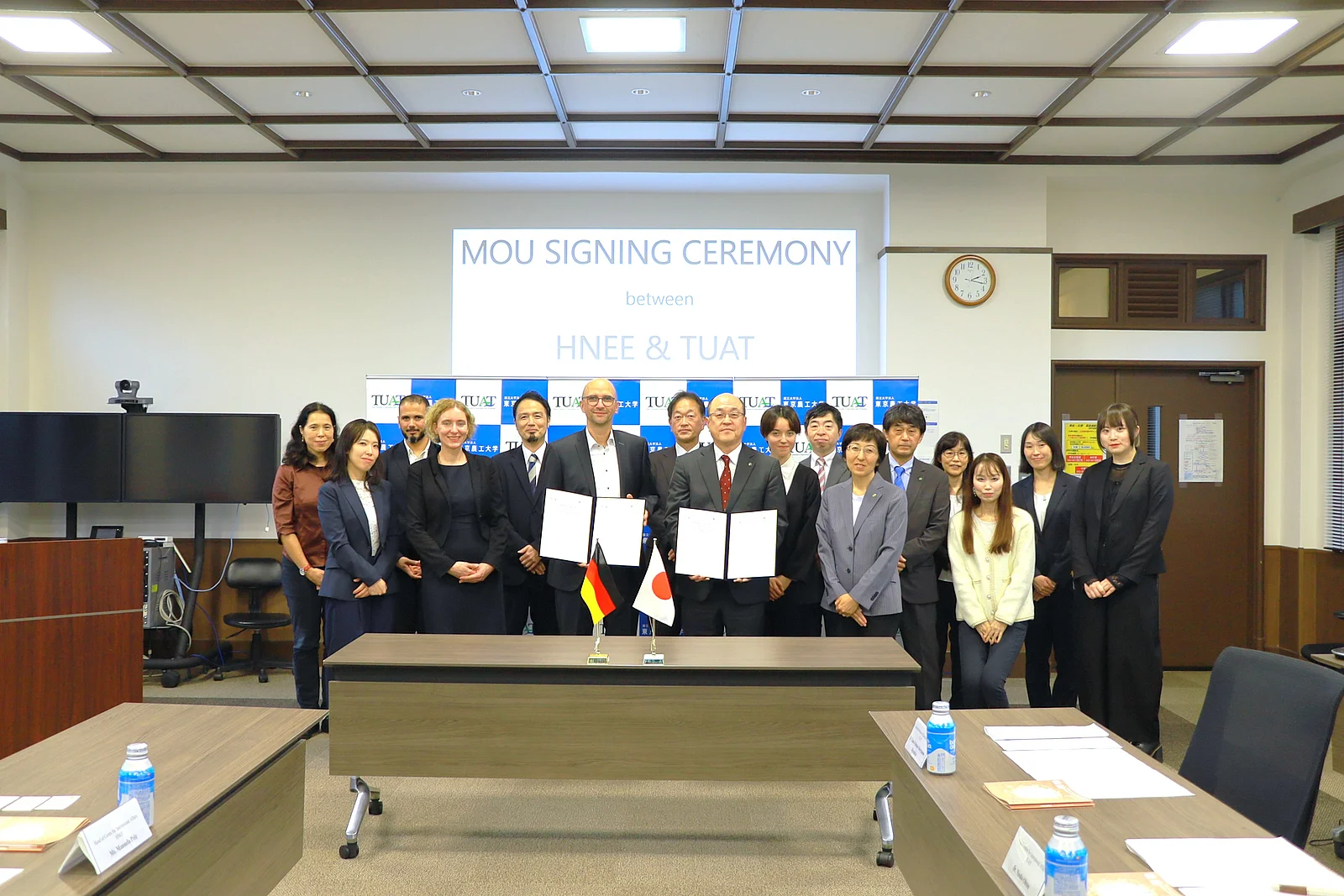
The delegation’s visit began at the Tokyo University of Agriculture and Technology (TUAT). Its focus on agricultural, environmental and engineering sciences offers numerous areas of common interest with the HNEE.
Discussions centred on the sustainable use of natural resources, the protection of biodiversity and the transfer of scientific findings into practice. The university’s own research forests and agricultural trial plots illustrate this connection. Discussions centred on the use of timber from the university’s own forests, collaboration with businesses and the interplay between basic and applied research. The early involvement of Bachelor’s students in research projects also provided inspiration for teaching.
Another key focus was a trilateral meeting with the Leibniz Centre for Agricultural Landscape Research (ZALF). This was also attended by Prof. Dr Sonoko Dorothea Bellingrath-Kimura, who is already collaborating with HNEE researchers. Together, the participants explored ways of deepening existing links between the three institutions.
The collaboration was formalised on 26 October 2026: HNEE President Prof. Dr Matthias Barth and TUAT President Prof. Dr Nobuhumi Nakamura signed a cooperation agreement. Dr Emu-Felicitas Ostermann-Miyashita, acting as the academic liaison officer between the two universities, has played a key role in the preparation and development of the partnership.
On this basis, concrete plans for joint research, teaching and academic exchange are now to be developed.
Akita International University – the challenge of an ageing society
(Kopie 2)
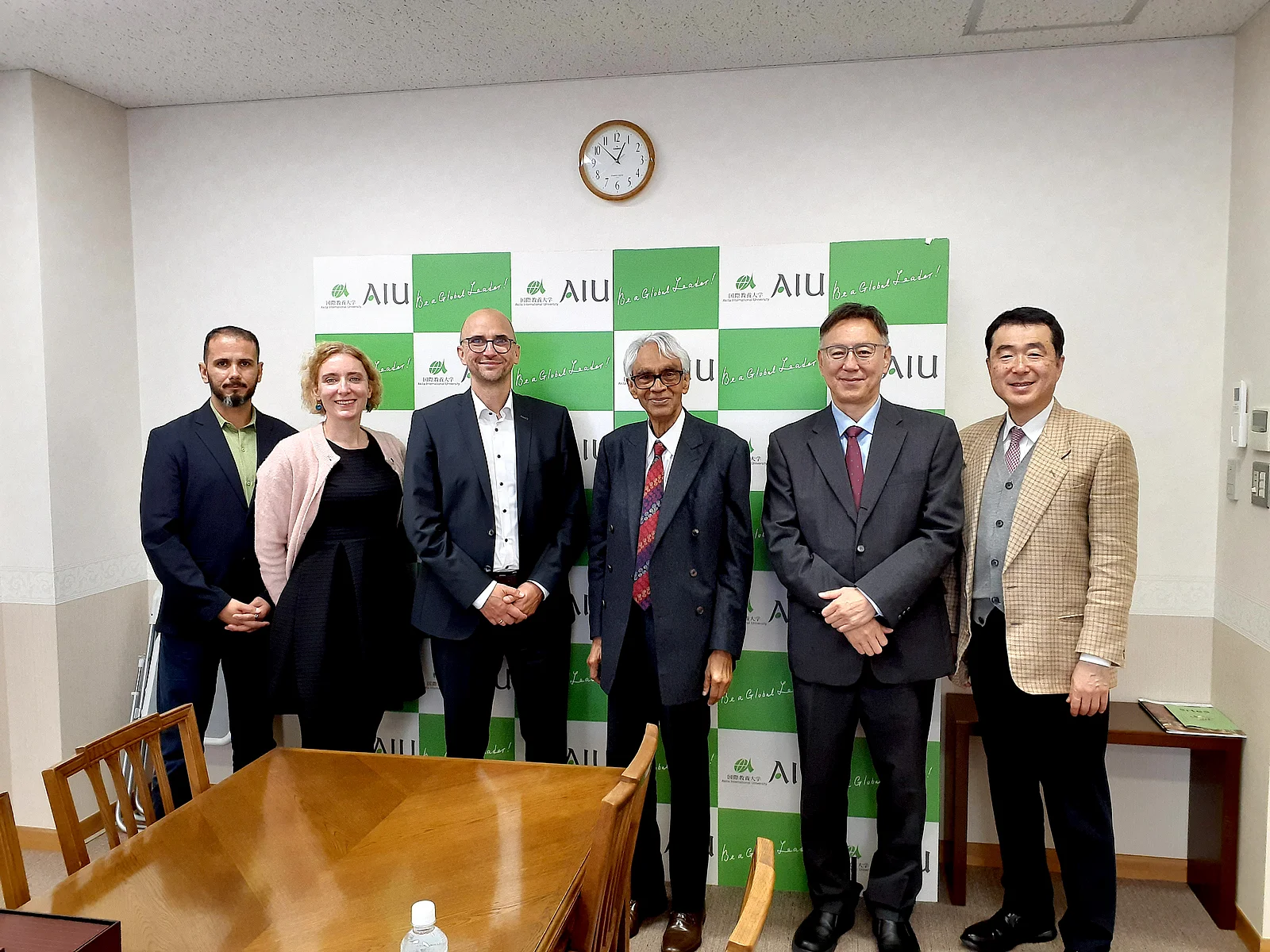
A shrinking population, an ageing society and the future of rural communities: during the visit to Akita International University (AIU), the focus was on social challenges that Brandenburg also faces. The HNEE already has a long-standing partnership with the university, which is also surrounded by woodland. Among its notable features is an impressive library.
The delegation discussed regional development and the integration of research, teaching and social engagement with AIU President Prof. Monte Cassim and Vice-President Prof. Dr Yoshitaka Kumagai. These topics were brought to life during a field trip to the small town of Gojome. In a former primary school, the BABAME base now provides space for start-ups, community activities and new ways of working.
Associate Professor Shogo Kudo conducts research into sustainability transformation and rural change. Another example of regional initiatives is the ‘awake’ forest cabin run by Konohoshi, a company founded by Yoshitaka Obara. It combines stays in nature and relaxation with sustainable tourism and regional value creation.
In the joint research project SOUZOU NO MORI, AIU, Akita Prefectural University and Akita University of Art are investigating new approaches to forest management, regional value creation and quality of life. The HNEE is already involved in this project.
Akita Prefectural University – Wood makes the difference
(Kopie 3)
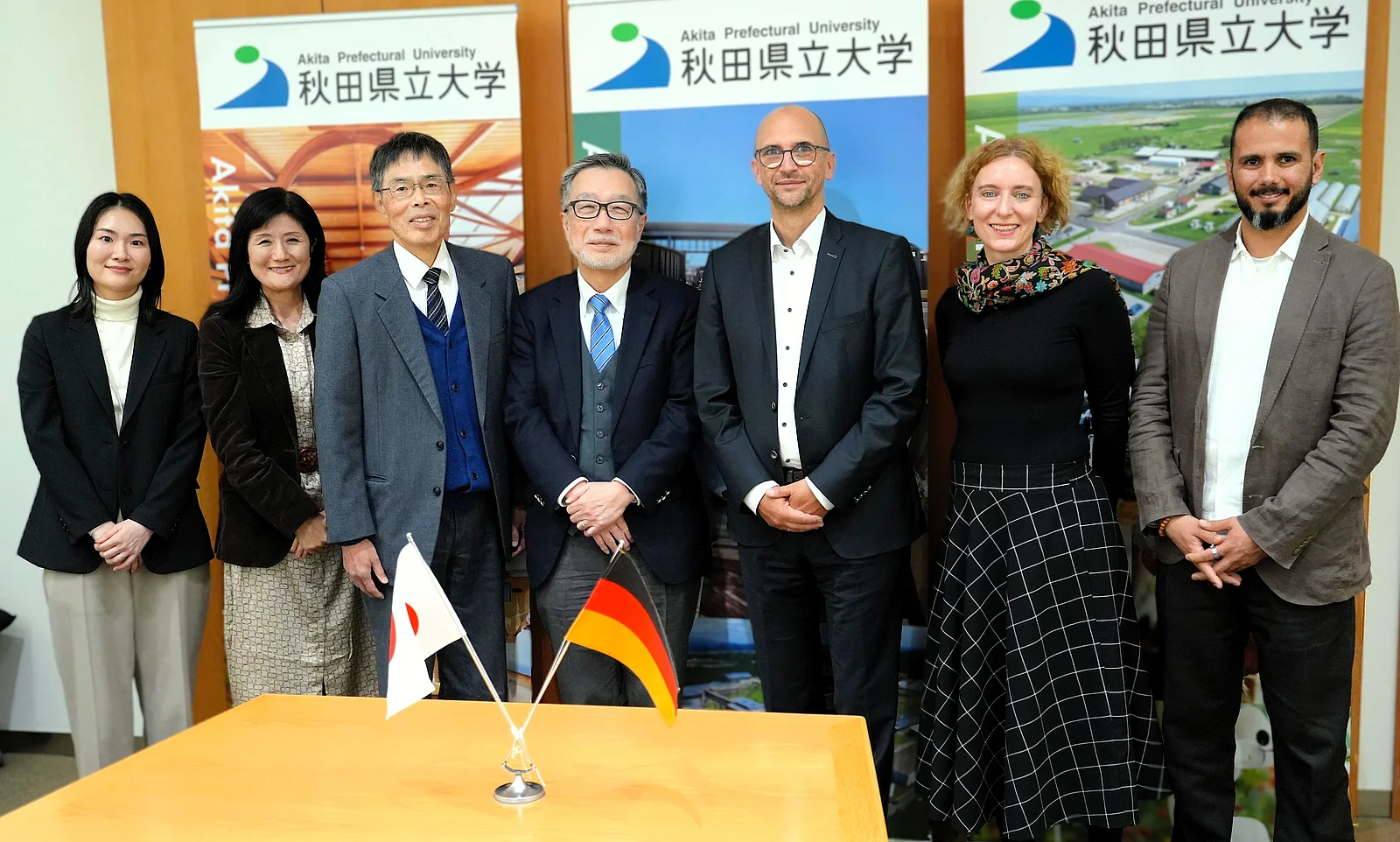
The visit to Akita Prefectural University (APU) highlighted wood as a renewable and versatile raw material. At the Institute of Wood Technology in Noshiro, Prof. Katsuhiko Takata and the institute’s director, Dr Firas Hawasly, guided the delegation through laboratories, workshops and research facilities.
The scope of the tour ranged from material testing and new timber-based materials, through spring-loaded seating and boat construction, to a small electric vehicle made from wood composite materials. The regional Japanese cedar (Sugi) plays an important role. Its material properties raise research questions whilst simultaneously opening up new possibilities for application. There are numerous areas of academic overlap with the wood sciences programme at HNEE.
On campus, the delegation also gained insights into chemistry and biotechnology, into Bachelor’s and Master’s study programmes, and into the laboratory work carried out by students. Vice-President Prof. Nobushige Nakazawa presented his research on regional yeast cultures.
Of particular interest is the long-term research and innovation project SOUZOU NO MORI. In this project, APU, Akita International University and Akita University of Art combine the natural sciences, technology, social sciences and design to jointly investigate forest resources and sustainable regional development.
HNEE is already involved: under the leadership of Prof. Dr Carsten Mann, a field study lasting several days in the Black Forest was designed to serve as a European case study. It examines forest and timber use and their significance for regional development, tourism and health.
Motoko Watanabe organised the visit and accompanied the delegation. The discussions provided impetus for further joint projects in research, teaching and knowledge transfer.
University of Tokyo – The Future of Forest Research
(Kopie 4)
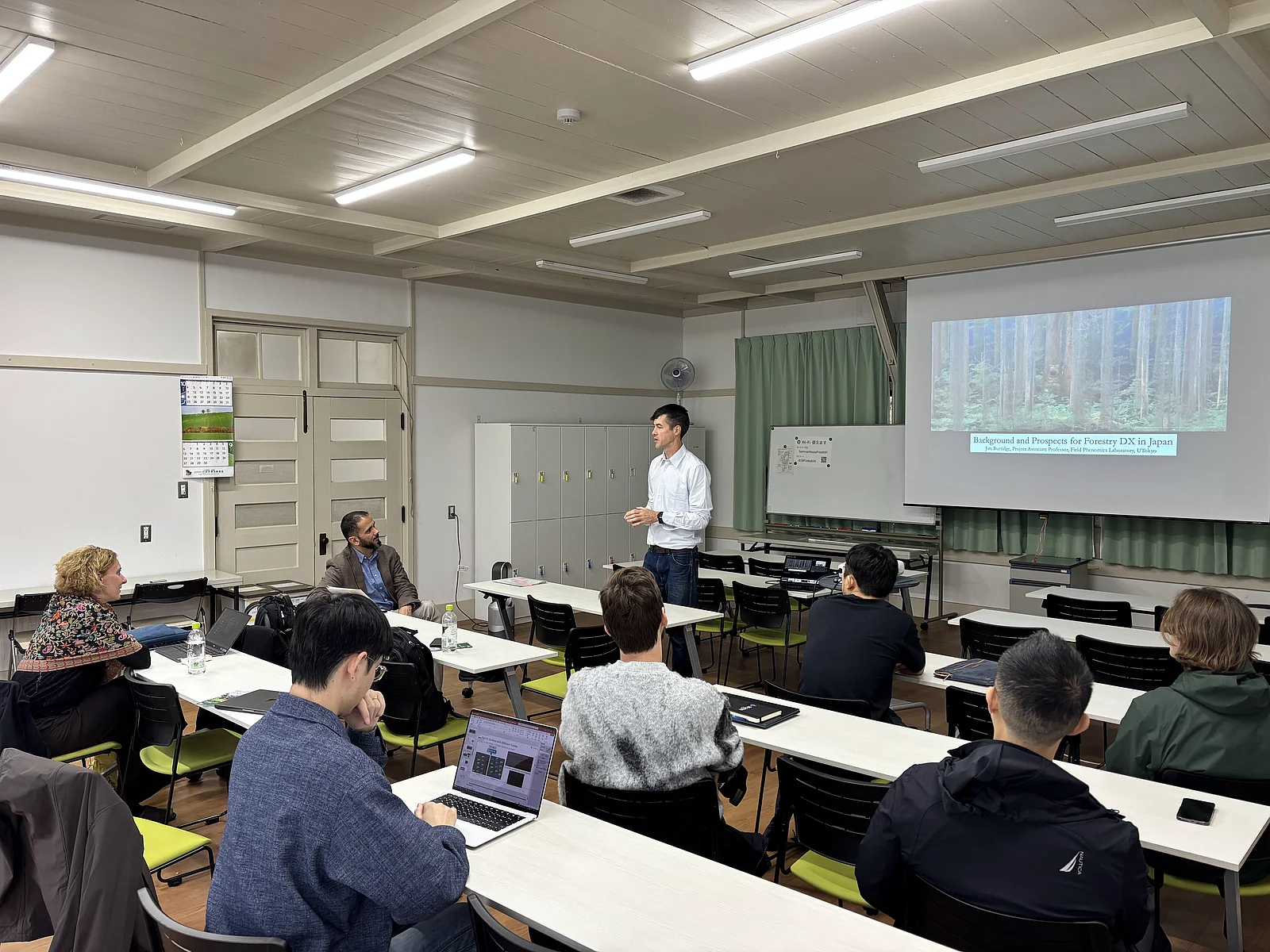
The visit to the University of Tokyo’s Tanashi Campus highlighted, amongst other things, a connection with Eberswalde dating back some 150 years. Associate Professor James Burridge recalled that the Japanese forestry scientist Matsuno Kan studied under Robert Hartig at what was then the Eberswalde Forestry Academy in the 1870s.
After his return to Japan, Matsuno Kan played a key role in establishing modern forestry science and vocational education. The Tokyo Forestry School, which he co-founded, later became part of what is now the University of Tokyo.
Today, digital methods are at the heart of the exchange. In a workshop on Forest Digital Twins and Plant Phenomics, the HNEE delegation discussed digital forest and plant models, data collection and artificial intelligence with James Burridge, Associate Professor Wei Guo and other researchers.
Wei Guo’s research combines agricultural sciences, computer science and technology. Using drones, robots, image processing and machine learning, his team records the growth and characteristics of plants. Such data can help to adapt plant breeding and cultivation methods to changing environmental conditions and to use resources more efficiently.
Insights into the Tanashi Research Forest and discussions with its director, Associate Professor Susumu Goto, rounded off the workshop. For the HNEE, this offers points of connection between forestry sciences, sustainable land use and environmental data analysis. The long-standing scientific exchange continues with new methods and research questions.
Kanazawa University – Exchange and joint research
(Kopie 5)
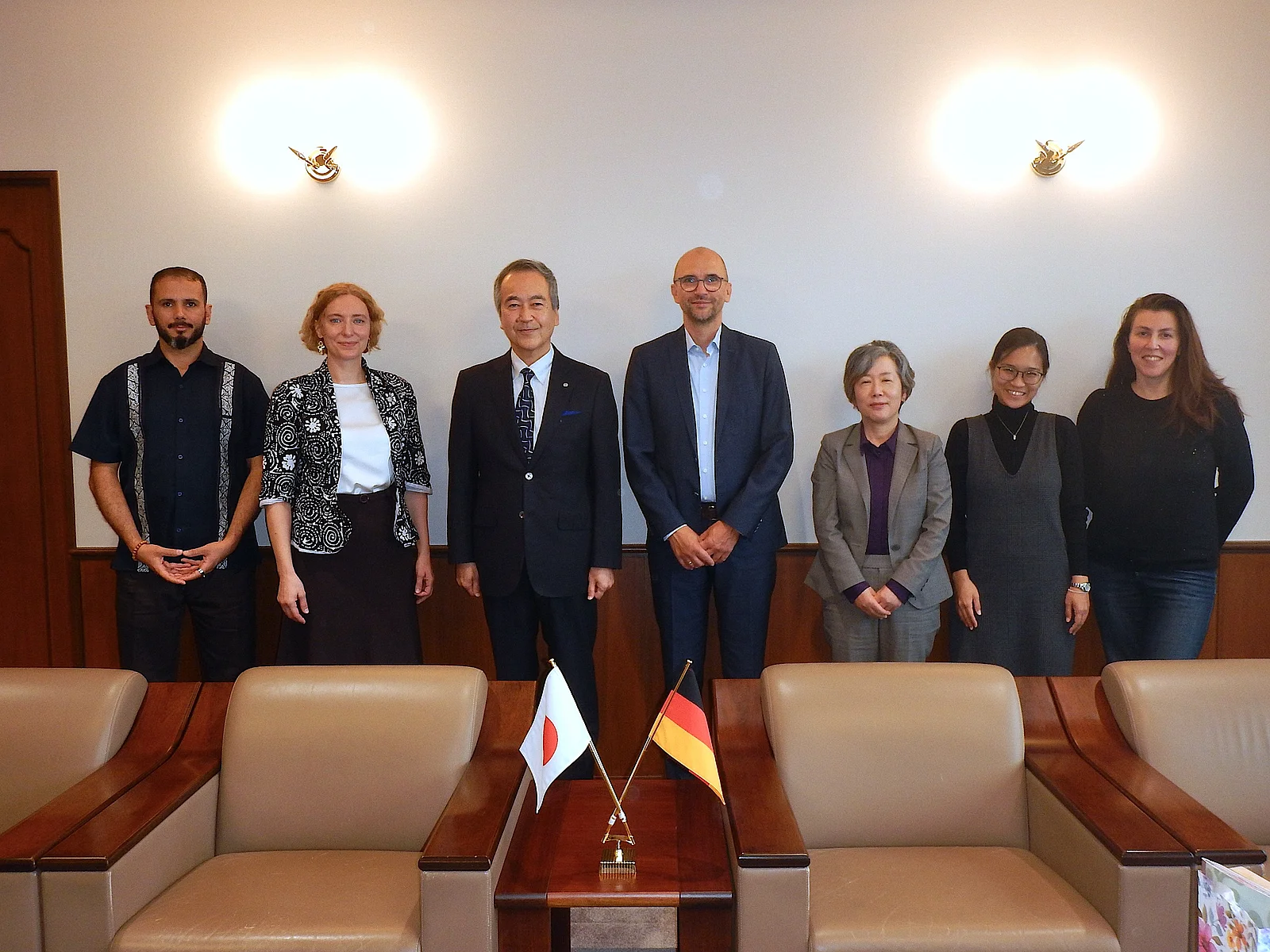
The collaboration between HNEE and Kanazawa University demonstrates how international study experiences can be linked to research into sustainable development. On the wooded Kakuma Campus, the delegation was welcomed by the University President, Prof. Dr Takashi Wada, the Vice-President, Prof. Dr Noriko Hasebe, and Associate Professor Aida Mammadova.
The university brings together the natural and social sciences as well as medicine. Aida Mammadova and HNEE Professor Dr Denise Matias have already established a collaboration. Together with students and other researchers from both universities, they published a research paper in 2026 on international exchange programmes in UNESCO biosphere reserves and geoparks. These sites serve as spaces for learning and research, where students work alongside local communities to address issues of sustainable regional development.
Aida Mammadova also heads a UNESCO Chair in intergenerational learning for sustainable development. Her work links international higher education with local knowledge and social engagement.
New opportunities could also arise at the interface between medicine and sustainability research: Kanazawa University has a strong medical research profile, whilst the Planetary Health Landscape Institute at HNEE investigates the interrelationships between human health, land use and intact ecosystems.
The visit also strengthened existing ties at university leadership level and opened up prospects for further joint research, teaching and international exchange.