

From student to professor: HNEE graduate returns as a professor
The Eberswalde University for Sustainable Development (HNEE) welcomes a new professor of forest growth and modelling. Following posts at the Helmholtz Centre for Environmental Research (UFZ) and the Thünen Institute of Forest Ecosystems, Prof. Dr Nikolai Knapp is returning to the university where he himself completed the Master's study programme in Forest Information Technology (FIT). His work focuses on modelling forest development, modern remote sensing methods and the question of how forests can be better adapted to climate change.
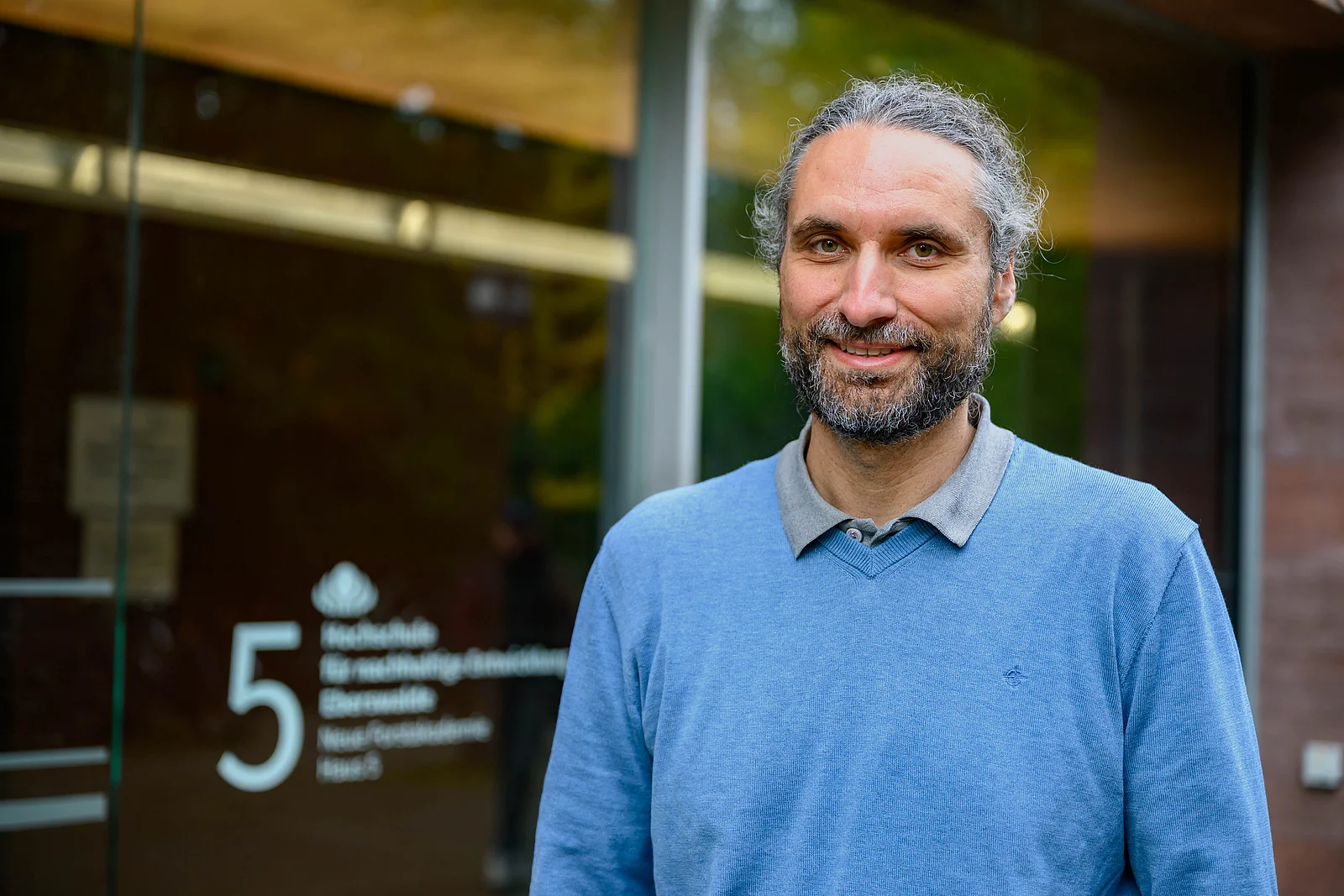
For Prof. Dr Nikolai Knapp, his appointment at the HNEE also marks a personal homecoming. Having grown up in Lower Franconia, he initially studied biology at the University of Würzburg. His main interests lay in tropical biology and field research in tropical rainforests. In light of deforestation and climate change, his focus increasingly shifted towards ecological modelling and remote sensing. In 2012, this focus led him to Eberswalde, where he completed the international Master's study programme in Forest Information Technology.
“For me personally, the FIT programme was the gateway to a career in science,” says Prof. Dr Knapp. He explains that combining biological specialist knowledge with IT tools and data science methods opened up new perspectives for him. His Master’s thesis immediately led to an opportunity to pursue a PhD at the Helmholtz Centre for Environmental Research (UFZ) in Leipzig. There, he worked on modelling tropical forests and lidar remote sensing, a method for three-dimensional mapping of forest structures.
At the UFZ, he was involved, amongst other things, in the development of the FORMIND forest growth model and conducted research in collaboration with the German Aerospace Centre (DLR) and NASA on the satellite-based mapping of forest structures. He later moved to the Thünen Institute of Forest Ecosystems in Eberswalde. There, he focused in particular on the nationwide forest and soil condition surveys, as well as on the effects of drought on the vitality and mortality of trees. Most recently, he worked on the ForestPulse project, which aims to provide comprehensive, remote-sensing-based forest information for Germany.
In his professorship, Prof. Dr Knapp aims to combine the biological and mathematical principles of forest growth with modern simulation methods. Students will learn how to model the development of forest stands and forecast their future under different environmental and climatic conditions. He will be involved in teaching on several forestry degree programmes, including Forestry (FoWi), International Forest Ecosystem Management (IFEM), Forest Information Technology (FIT), Forest System Transformation (FST) and the Global Change Management (GCM) programme.
A particular focus of his future research will be on so-called digital twins of the forest. This involves bringing together information from remote sensing, forest monitoring and growth models in order to simulate the development of forest stands as realistically as possible.
His vision is that, in future, forest growth models should be so easily accessible that they can be used in forestry practice without the need for complex data processing. “At some point, using forest models should be no more complicated than reading yield tables,” he says, describing his goal.
For research and teaching, the newly appointed professor sees links to the disciplines of silviculture, forest ecology, soil science, forest surveying, remote sensing and data science. He also believes that the proximity to the Brandenburg State Forestry Authority and the Thünen Institute offers excellent conditions for joint projects and practice-oriented vocational education.
Prof. Dr Knapp has been associated with the HNEE in research and teaching for many years. Since 2016, he has regularly taught an elective module on LiDAR remote sensing as part of the FIT degree programme. With his appointment, he will be able to help shape teaching and research at his former university. “I am delighted that I can now play a permanent role in shaping teaching at the HNEE and help to influence the content of the FIT programme as well as that of the other forestry degree programmes.”