

Second Start-up Challenge: Winning teams bring new technologies into industrial practice
The winning teams of the second Schwedt Start-up Challenge have been announced: Ligaro, Revoltech and Spark e-Fuels impressed the expert jury with their concepts for ‘Sustainable Materials in the Process Industry’. Following a three-month concept phase, they can now further develop their technologies at the Schwedt industrial site and test them under real-world conditions. Research and development contracts worth up to 300,000 euros each are available for this purpose.
Ten teams from Germany and Poland had three months from June to further develop their technological approaches, in collaboration with the Start-up Lab and the participating industry partners, into concrete pilot projects for Schwedt. At the Pitch Day on 23 September 2026, they presented their concepts to the expert jury. The focus was on technologies that replace fossil raw materials, make use of industrial waste and recycled materials, or enable new circular materials and production processes. A key consideration was also how the solutions could be practically tested under the conditions of the industrial site and, in the long term, integrated into industrial processes.
The Startup Challenge is a key initiative of the Schwedt Startup Lab, a joint project between the Eberswalde University for Sustainable Development (HNEE), LEIPA Group GmbH (LEIPA) and PCK Raffinerie GmbH (PCK). The Startup Lab specifically brings together scientific knowledge transfer, young technology companies and established industry in order to put new solutions for the transformation of the Schwedt industrial site into practice.
The industrial partners who took part in the first challenge are once again involved this time round. Alongside PCK and LEIPA, ENERTRAG SE and VERBIO SE are also participating. The four companies are providing the start-ups with industrial infrastructure, material and energy flows, and specialist know-how. This enables the teams not only to further develop their technologies conceptually, but also to devise concrete application scenarios for Schwedt and test selected solutions in an industrial setting.
HNEE is contributing its scientific expertise directly to the Start-up Lab: Prof. Dr Uwe Demele, Professor of Responsible Business Management and Ecological Sustainability, is providing scientific guidance for the project. Together with industry partners and start-ups, scientific perspectives, practical experience and innovative technological approaches are thus combined to develop viable solutions for the transformation of the industrial site and to put them into practice.
Prof. Dr Matthias Barth, President of HNEE: “Sustainable transformation succeeds when the right partners come together, different areas of expertise interlock, and innovative ideas are given the space to prove themselves in practice. This is precisely what the Schwedt Start-up Lab stands for: academia, established industry and young technology companies contribute their respective strengths and jointly develop solutions that can be tested in practice at the site. This creates new prospects for Schwedt as a sustainable and competitive industrial location – whilst also yielding insights and approaches that may be relevant to other industrial regions. “As a university of applied sciences, we see it as our task to forge such connections and, together with strong partners, to provide scientific guidance for new solutions and support them on their path to practical application.”
The conditions for this are particularly favourable in Schwedt: the town is an industrial centre in north-eastern Brandenburg, with more than 3,000 jobs in petroleum processing, paper production and the refining of regional biomass, as well as a large number of industrial service companies. At the same time, the region faces the challenge of further developing its industrial value creation in a climate-neutral and circular economy-oriented manner.
To this end, the region possesses potential that can be directly harnessed for the deployment of new technologies: renewable energy, renewable raw materials from agriculture and Forestry, existing industrial facilities, material and waste streams, as well as expertise in engineering and plant construction. The Startup Challenge brings these existing resources together with the technological solutions offered by young companies.
The aim thus goes beyond individual pilot projects: the aim is to test how new material cycles can be created, how fossil resources can be replaced, and how existing industrial structures can be further developed for climate-neutral production.
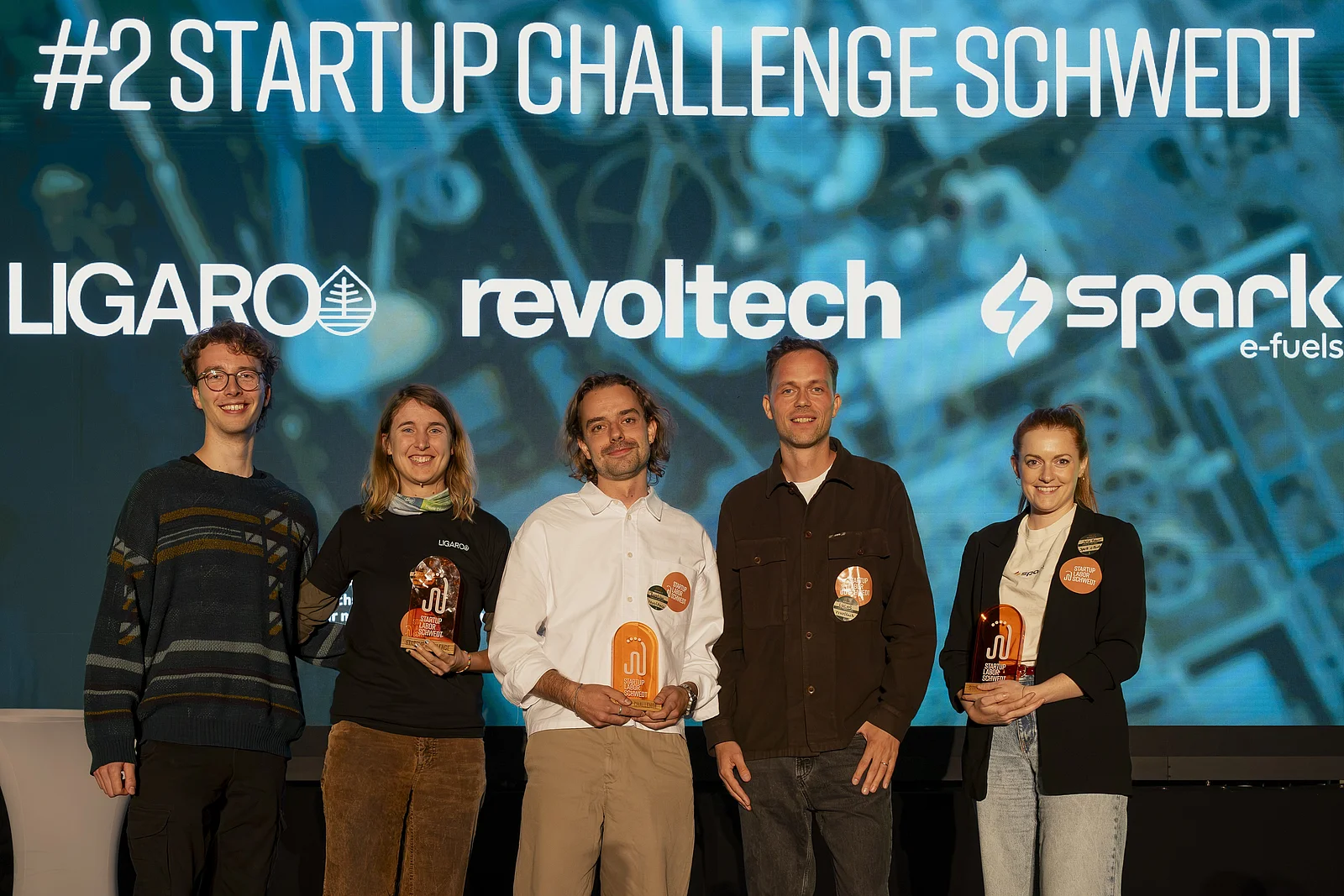
An overview of the winning teams from the second Start-up Challenge
Ligaro GmbH
This start-up utilises plant-based proteins from raw material sources that have so far been little exploited, and uses them to develop a novel, low-carbon and recyclable adhesive for the timber and packaging industries. This adhesive can partially or completely replace petroleum-based industrial adhesives – for example, in chipboard or parquet – whilst maintaining high mechanical performance.
The project also creates an industrial application for regional, locally sourced waste streams, thereby strengthening material cycles and industrial symbiosis. A pilot plant and batch reactors in Schwedt are to be used for this purpose. If successfully implemented, fossil-based raw materials can be substituted, CO₂ emissions reduced and new regional value-added chains established between raw material production, adhesive development and wood processing. VERBIO SE is supporting the project with raw materials, product data and expertise in processes and applications.
Revoltech GmbH
With LOVR™, Revoltech is developing a bio-based, recyclable and compostable alternative to genuine leather and synthetic leather. In Schwedt, Revoltech aims to further develop the material using existing industrial infrastructure and make it industrially scalable.
During the implementation phase, existing fibre streams at the LEIPA plant are to be tested for use in the LOVR™ material. Furthermore, LEIPA and Revoltech are aligning the plant’s facilities at the site with LOVR™’s requirements and are assessing whether this could also enable a potential production trial at a facility in Schwedt in the future.
Spark e-Fuels is developing a flexible chemical looping technology for the production of renewable CO and synthesis gas as feedstocks for green chemicals and synthetic fuels. As part of the ‘e-CO Schwedt’ project, in collaboration with LEIPA and ENERTRAG SE, the Reverse Water-Gas Shift Chemical Looping (RWGS-CL) technology – which has already been demonstrated on a pilot scale – is to be expanded to include Methane Dry Reforming Chemical Looping (DRM-CL). The aim is to demonstrate for the first time on a pilot scale that the same technology platform can utilise either CO₂ and green hydrogen or CO₂ and methane, depending on availability. This adds a new dimension – feedstock flexibility – to the existing load flexibility.
First Challenge is already having an impact
The first Startup Challenge demonstrates that concrete applications can emerge from this collaboration. In 2025, five companies were selected for the implementation phase. Two of the winning teams from that year presented their experiences at this year’s Pitch Day.
Rement, for example, is further developing a process that uses CO₂ and renewable energy to break down concrete waste into reusable raw materials such as sand and calcium carbonate. Natura Materia is developing fully recyclable, paper-based insulating packaging designed to replace conventional plastics and composite materials. In Schwedt, the product is to be further developed to market readiness and a pilot production plant is to be set up. In doing so, the start-up benefits from the infrastructure and recycling expertise of the LEIPA Group as its industrial partner.
Both projects demonstrate how start-ups and established industrial companies in Schwedt are working together on the development and practical implementation of new, circular economy-oriented technologies.
Pitch Day marked the conclusion of the SCHWEDT TRANSITION DAYS 2026
Pitch Day also marked the conclusion of the SCHWEDT TRANSITION DAYS 2026, which were organised from 21 to 23 September 2026 by the town of Schwedt/Oder, the Schwedt Start-up Lab and the BMW Foundation Herbert Quandt. The three-day series brought together stakeholders from industry, politics, academia, the start-up scene and civil society to discuss prospects for the transformation of Schwedt as an industrial centre – ranging from public dialogue and in-depth technical discussions to concrete technological solutions presented at the concluding Pitch Day.
About Startup Labor Schwedt
Startup Labor Schwedt is a project run by the Eberswalde University for Sustainable Development (HNEE), LEIPA Group GmbH and PCK Raffinerie GmbH. It creates links between academia, start-ups and industry and develops formats through which innovative technologies for industrial transformation can be tested and further developed in Schwedt.The project is funded by the EXIST funding programme of the Federal Ministry for Economic Affairs and Energy (BMWE), following a resolution by the German Bundestag, and by the Brandenburg Ministry of Science, Research and Culture.
Further information:
Concept, programme and objectives of the Startup Challenge Schwedt, as well as brief profiles of the jury members
https://startuplabor-schwedt.de/innovationen/startup-challenge/
Please do not hesitate to contact us if you have any queries.