BRI at EuroMAB 2026: Interwoven Futures
Under the theme “Interwoven Futures”, EuroMAB 2026 – the European and North American network of UNESCO’s Man and the Biosphere (MAB) Programme – took place on Vancouver Island, Canada, from 14 to 18 September. Hosted by the Mount Arrowsmith Biosphere Region, the conference brought together around 180 participants from UNESCO Biosphere Reserves across Europe and North America to exchange perspectives on biodiversity conservation, sustainable development, and collaborative and innovative approaches to global challenges.
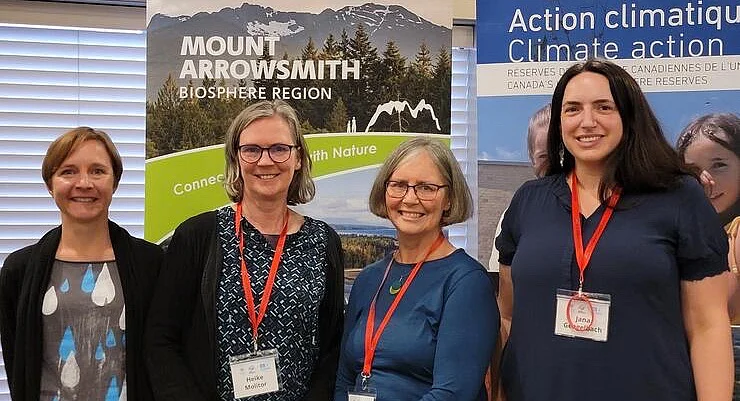
The HNEE Biosphere Reserve Institute (BRI) was represented by Jana Gengelbach, Prof. Dr Heike Molitor and Franziska Rottig, as well as by Prof. Dr Maureen Reed from the University of Saskatchewan in her capacity as a member of the BRI Governing Board.
In addition to attending specialist presentations, interactive workshops and an excursion to the Mount Arrowsmith Biosphere Region, the BRI team co-organised and contributed to several workshops together with international partners, including the Succow Foundation, the TRANSECTS network and the Lower Saxony Elbe Valley Biosphere Reserve.
In the session “Context Matters: Exploring Differences in Transdisciplinary Education Needs Between Sub-Saharan Africa, Europe, and North America”, Jana Gengelbach, Prof. Dr Heike Molitor and Franziska Rottig presented the BRI project “Promoting African Student Researchers for Sustainable Development in UNESCO Biosphere Reserves”. The project aims to strengthen transdisciplinary and practice-oriented research through training, networking and knowledge exchange. The session provided an opportunity to discuss differences in transdisciplinary education needs across regional contexts. Particular attention was given to the integration of ethical perspectives into transdisciplinary research and to the competencies students need to engage effectively in research within biosphere reserves.
Together with partners from the TRANSECTS network, BRI also co-organised the workshop “Mapping Ripples, Measuring Impact: Participatory Evaluation in Biosphere Regions and Reserves Using Ripple Effects Mapping”. The workshop explored how evaluation is currently used in biosphere reserves and introduced Ripple Effects Mapping as a participatory approach for identifying, documenting and understanding the impacts of community-engaged work.
Another joint workshop, “From Recognition to Action: Advancing the Network of People for Living Waters Biosphere Reserves”, was organised together with the Succow Foundation and the Lower Saxony Elbe Valley Biosphere Reserve. The session explored how the recently established and UNESCO-recognised network can be further developed and translated into concrete collaboration and benefits for biosphere reserves, their communities and ecosystems.
Prof. Dr Heike Molitor was also invited to join the panel “Beyond Networking: Towards Assessing the Impact of UNESCO Networks”. She contributed an academic and research perspective based on experiences from BRI to the discussion on how the impact and added value of MAB networks can be monitored and assessed. The exchange considered both measurable indicators and less visible outcomes, such as new relationships, shared knowledge, trust and joint research.
The BRI’s participation in EuroMAB 2026 provided valuable opportunities to exchange experiences with partners from UNESCO Biosphere Reserves across Europe and North America and to develop new perspectives for future collaboration. Discussions throughout the conference highlighted the importance of bringing together diverse forms of knowledge, including Indigenous and intergenerational perspectives, and of strengthening transdisciplinary approaches to the sustainable development of biosphere reserves.
Through its contributions to EuroMAB 2026, BRI continues to strengthen its international cooperation within UNESCO’s World Network of Biosphere Reserves and to connect research, education and practice across regions and disciplines.