


Personalised course content
This Master’s programme equips you to take a holistic view of rural regions in all their diversity and complexity. To this end, we combine knowledge from the natural sciences, planning sciences and social sciences.
The entire programme has a practical focus: exercises, field trips and project work are integral parts of every semester. In each module, you will learn how landscape, its use and social developments interact within a regional context.

Modules per term
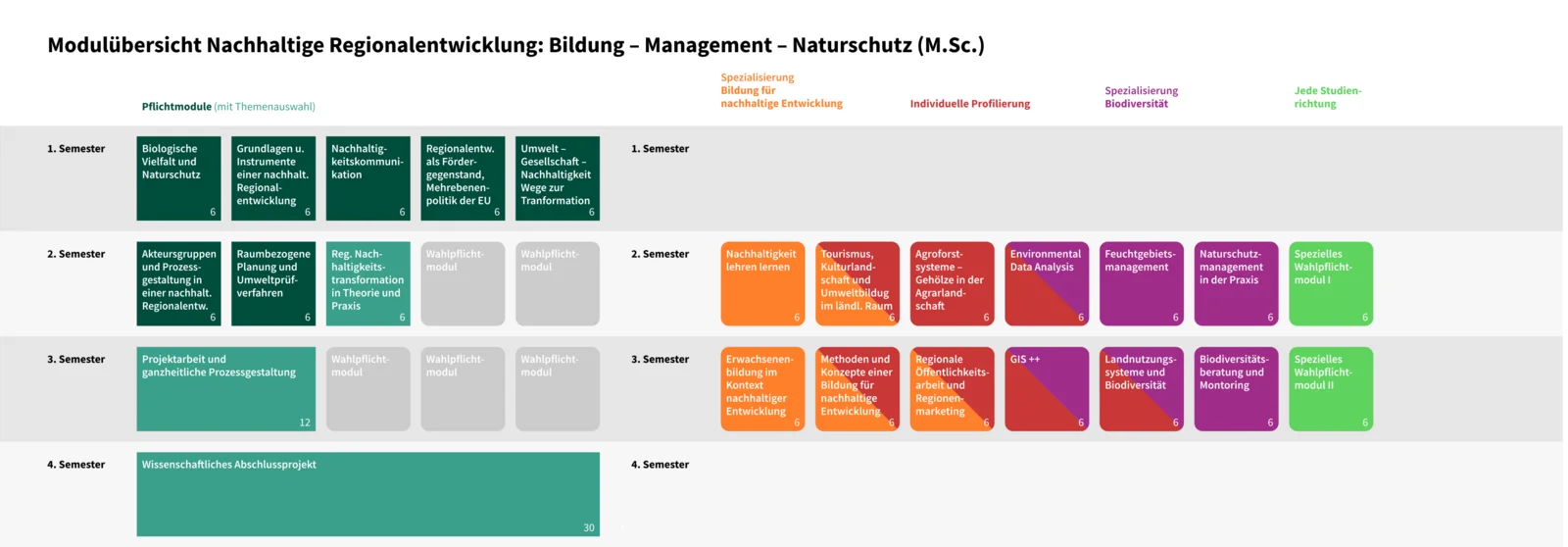
In the first semester, we cover the fundamental subject knowledge in compulsory modules, which forms the basis for the rest of the course. At the same time, this semester offers a good opportunity to get to know one another as a group – because a strong sense of community and mutual exchange are particularly important to us.
The module explores various approaches and areas of action relating to biodiversity and nature conservation, and explains the differences between dynamic and static perspectives. It also examines conservation requirements and land-use demands, as well as various conservation strategies. Furthermore, the module examines a specific topic (e.g. wind power) and analyses its acceptance and success.
Students learn to identify the characteristics and endogenous potential of regions. They are then able to assess the driving forces affecting regions and evaluate the impact of various instruments on regional development processes.
This module analyses and classifies environmental education concepts. You will be able to design environmental psychology interventions based on theoretical and empirical findings. This module comprises two sub-modules: Fundamentals of Environmental Education/Education for Sustainable Development and Environmental Psychology in the Context of Educational Practice.
Students will gain an understanding of the legal and political framework within which state-funded regional development takes place in Europe. They will learn about the rationale behind such interventions and the institutions involved, and will be able to critically assess both. In addition, aspects of economic development and private-sector support in regional development will be addressed and discussed.
The aim of the module is to work with the group to establish a ‘common language’ and a shared understanding of the concepts and terminology of sustainable development, in order to develop a common framework for sustainable regional development.
In the second semester, you can choose between three specialisations:
- Environmental Education / Education for Sustainable Development (ESD)
- Biodiversity (Bio)
- Individual specialisation (Ind.)
Depending on your specialisation, various compulsory elective modules are available to you (see diagram).
In the summer semester, you will put what you have learnt into practice through a number of group projects. On field trips to biosphere reserves and rural communities, you will work on practical projects and apply your theoretical knowledge directly on site.
This module focuses on the stakeholders who influence the shaping of rural development. Students gain an in-depth understanding of the perspectives and decision-making processes of various stakeholder groups. Students receive training in facilitation and explore various participatory methods.
The course covers the spatial planning system in Germany and the environmental assessment procedures for projects with spatial implications. Students will gain an understanding of the impact of renewable energy (RE) on the landscape. They will be able to formulate and address requirements for the landscape-compatible expansion of RE and for climate adaptation measures.
In this module, students explore a fundamental shift towards sustainability – a sustainability transformation – at the regional level. They are introduced to transformation theories and examine specific sustainability projects in regional development (e.g. in biosphere reserves).
Through practical exercises related to cross-cutting themes within the programme, students learn how to collect and process spatial (environmental) data. In this module, they have the opportunity to plan their own projects.
Students will be equipped to assess and evaluate the current state of wetlands. They will learn about methods for the restoration of existing wetlands and the development of new ones, as well as for maintaining their current condition, against the backdrop of climate change adaptation and mitigation. A range of methodologies and guidelines will be taught.
Working in groups, students will plan and develop an educational concept within the context of sustainable development. They will implement and reflect on this concept at the end of the module.
Students explore nature conservation management both within and outside protected areas: they learn about conservation strategies and their implementation, ranging from practical individual measures for nature conservation and landscape management to large-scale management approaches in terrestrial and aquatic environments. Through fieldwork and excursions to selected projects, they engage with a variety of stakeholders and operate within different contexts.
Students learn to design, analyse and evaluate tourism and environmental education concepts in rural areas.
The module is divided into two sub-modules: 1) Tourism in rural areas (ESD, Ind), 2a) Cultural landscape (Ind) and 2b) Non-formal environmental education in leisure time / interpretation (ESD).
Students will gain the ability to understand agroecological interactions, the political framework and the potential of various agroforestry systems. They will learn to assess and evaluate these systems in terms of their practical feasibility.
The Special Compulsory Elective Modules (syn. Special Topic) I and II may be taken as part of other Master’s programmes at HNEE or at other universities. The following regulations apply to both modules: The modules in question must be thematically relevant to the chosen specialisation within the NaRegio Master’s programme and must comprise at least the same number of ECTS credits (6 ECTS credits). Students must submit relevant information to the module coordinator prior to the registration process for the HNEE’s compulsory elective modules. The module coordinator will then assess and, where appropriate, confirm the suitability of the chosen module. The student is responsible for forwarding this confirmation, together with proof of the examination results achieved, to the Examinations Office.
Individual modules, in particular the compulsory elective modules “Special Topic I” and “Special Topic II”, may be completed in other Master’s programmes at the Eberswalde University for Sustainable Development and at partner universities. The following regulations apply to both modules: The modules in question must be thematically relevant to the “Sustainable Regional Development” Master’s programme and comprise at least the same number of ECTS credits. The student must submit relevant information to the module coordinator. The module coordinator will then confirm the suitability of the chosen module. The student is responsible for submitting this, together with proof of the examination results achieved, to the Examinations Office.
The special topics may be recognised for one of the three specialisations, provided that their content contributes to the development of the student’s profile. The lecturers responsible for the specialisations (Environmental Education – Prof. Molitor / Biodiversity Management – Prof. Stöckmann / Individual Profiling – Prof. Peters) decide on the recognition of credits.
The third semester is primarily devoted to a comprehensive practical project. Working in teams of four to six students, you will collaborate with industry partners to address current issues affecting the region. Examples of past projects include:
- the design of an educational trail in the forest,
- an innovative educational concept such as a murder mystery dinner,
- a location-specific grazing concept involving horses, or
- the development of a regional value chain from ancient grains to bread.
In this module, students work in groups (of 4–6 students) to carry out a methodologically guided project independently. Current topics are explored in collaboration with industry partners throughout the semester and are selected by the students before the start of each lecture period. The theoretical focus is on the four levels of holistic project design, as well as methods of project planning and project management.
Students explore nature conservation advice for the agricultural sector and other land users. They examine measures to conserve and promote biodiversity in the cultural landscape. Students are familiar with current monitoring programmes in the context of nature conservation and the requirements these entail.
In addition to the fundamentals of adult education, this module covers practical content. Students learn to analyse this content in the context of sustainable development.
Students will be equipped to apply complex concepts relating to the fields of application of geographic information systems. Through practical exercises, they will learn to design, implement, commission and evaluate research and development projects.
Students will understand the links between management practices – particularly in agricultural land-use systems – and biodiversity. They will learn the biological and ecological principles of environmentally sustainable land use and the various approaches to achieving nature conservation objectives.
The aim of the module is to enable students to apply participatory methods in education for sustainable development. The module covers participatory methods in both theory and practice.
Students will gain a deeper understanding of two practical tasks: 1. The fundamentals and tools of public relations, as well as appropriate public communication strategies in a regional context.
2. The fundamentals of location marketing, the requirements for effective location marketing, and suitable tools for its implementation.
The Special Compulsory Elective Modules (syn. Special Topic) I and II may be taken as part of other Master’s programmes at HNEE or at other universities. The following regulations apply to both modules: The modules in question must be thematically relevant to the chosen specialisation within the NaRegio Master’s programme and must comprise at least the same number of ECTS credits (6 ECTS credits). Students must submit relevant information to the module coordinator prior to the registration process for the HNEE’s compulsory elective modules. The module coordinator will then assess and, where appropriate, confirm the suitability of the chosen module. The student is responsible for forwarding this confirmation, together with proof of the examination results achieved, to the Examinations Office.
Individual modules, in particular the compulsory elective modules “Special Topic I” and “Special Topic II”, may be completed in other Master’s programmes at the Eberswalde University for Sustainable Development and at partner universities. The following regulations apply to both modules: The modules in question must be thematically relevant to the “Sustainable Regional Development” Master’s programme and comprise at least the same number of ECTS credits. The student must submit relevant information to the module coordinator. The module coordinator will then confirm the suitability of the chosen module. The student is responsible for submitting this, together with proof of the examination results achieved, to the Examinations Office.
The special topics may be recognised for one of the three specialisations, provided that their content contributes to the development of the student’s profile. The lecturers responsible for the specialisations (Environmental Education – Prof. Molitor / Biodiversity Management – Prof. Stöckmann / Individual Profiling – Prof. Peters) decide on the recognition of credits.
In the fourth semester, you will write your individual Master’s thesis. An accompanying seminar and a module on socio-ecological research methods will support you in your independent academic work.
Writing a master's thesis.
- Key characteristics of socio-ecological research
- Stages in the research process
- Survey methods and data analysis
- Interpretation of results and application in practice
Critical reflection on students’ research designs.