




Personalised course content
The aim of the programme is to equip students to meet the demands of modern tourism management through data-driven decision-making in line with the 17 SDGs.
The course content covers all levels of the value chain (businesses, destinations, policy) in both German-speaking and international contexts.
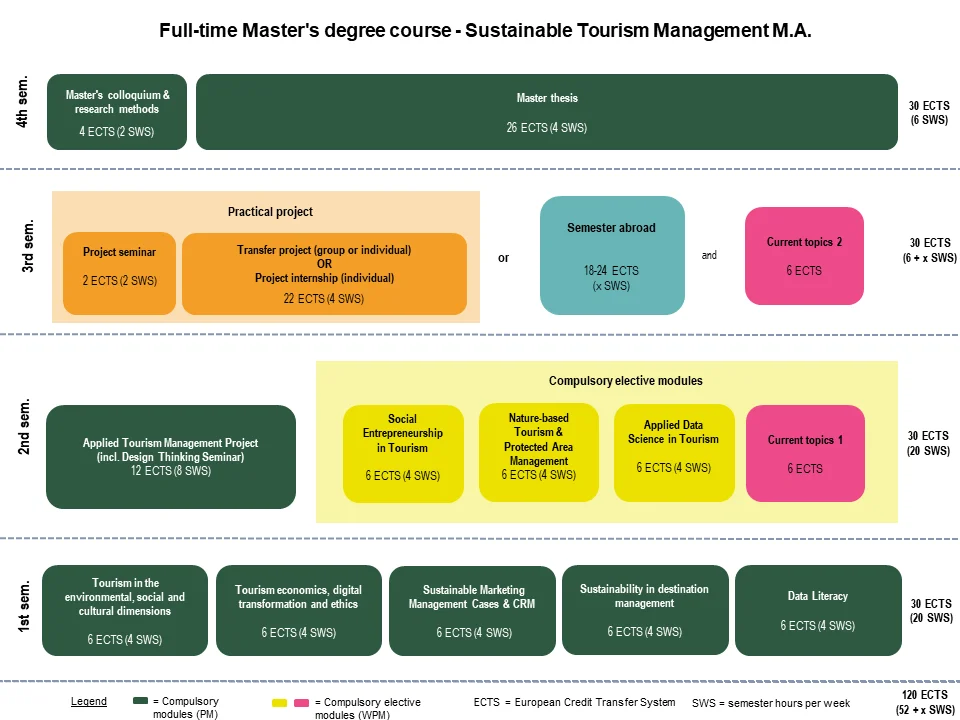
The programme consists of four semesters. In the first semester, we take a holistic look at tourism within the destination as well as in marketing, and deepen our understanding of data and sustainability and the interplay between these two key areas.
In the second semester, we deepen our knowledge of direct implementation through a major applied project with industry partners, and in the third semester, students can choose between a practical project or a semester abroad. The programme concludes with the Master’s thesis in the fourth semester.
Modules per term
In the first semester, you will explore topics relating to economic, environmental and social sustainability, as well as marketing and management. You will practise academic research methods and gain an introduction to data literacy.
In this module, we explore the economic aspects of the tourism industry, introducing you to digital business models, the internet and platform economy, and the impacts of digital transformation. We examine and discuss critical economic perspectives as well as the ethical implications of digitalisation, the economy and the tourism industry.
In this module, you will be introduced to the fundamental principles of sustainable development, which we will then apply to tourism. Specifically, we will examine the environmental, social and cultural impacts of tourism, as well as potential solutions for making tourism more sustainable. The economic dimension is covered in the ‘Tourism Economics’ module.
This module covers the fundamentals of marketing and the specific aspects of tourism marketing. You will learn about marketing strategy, planning, positioning, communication and distribution as a strategic approach to marketing. The course examines sustainable business management in the field of marketing from both academic and practical perspectives.
The module covers definitions of a destination, a destination management organisation (DMO), levels of spatial planning in Germany, environmental impact assessments and impact regulations, tourism planning as a function of destination management, and the development of tourism strategies. You will gain an understanding of sustainability in destination development and sustainable mobility.
Data literacy refers to the ability to handle data confidently. Through your own work with data, you will learn how to find, generate, analyse, process and communicate it.
From the second semester onwards, the choice is yours!
During the course of your studies, you must select a total of at least four compulsory elective modules. In the second semester, three compulsory elective modules from the programme are available to you. Under ‘Current Topics 1’, we also offer a compulsory elective module on a current topic, which can alternatively be replaced by a module from other HNEE programmes or even from international partner universities, e.g. in Italy.
In the third semester, you can then choose compulsory elective modules via the “Current Topics 2” module, if you wish.
Alternatively, you also have the option of ‘deferring’ a compulsory elective module and taking part in the field trip in the fourth semester.
In the compulsory module, teams are formed to work on a project for an external partner (e.g. a tourism company or a destination management organisation). In a Design Thinking section, you will be guided in addressing the partner’s problem with creative solutions. The teams then carry out the project independently, supported by short lectures, and present the results to the partners in the form of a poster presentation.
In the compulsory elective module, students work in teams to develop their own business concept or, individually, to devise a pathway into the labour market for social enterprises.
You will receive an introduction to nature conservation, conservation strategies, types of protected areas, protected area management, visitor management and infrastructure, nature and ecotourism offerings, the economic importance of tourism for protected areas, UNESCO World Heritage sites, geoparks and starlight parks, and tourism, as well as national and international case studies.
This compulsory elective module provides a practical introduction to working with data to address issues in the tourism sector.
A compulsory elective module is offered here, based on current topics. This could, for example, be Environmental Management, Reporting and Certification.
In the third semester, our students can choose between two options: a semester abroad combined with the ‘Current Topics 2’ module, or the practical project comprising the project seminar and either a transfer project or a project placement.
In a joint project seminar, you will be prepared to manage your project. This will be followed by several one-to-one meetings with the lecturer supervising the project.
In a transfer project, students work in groups to develop a project for a partner organisation. In doing so, they apply knowledge gained at university to real-world practice. Transfer projects are mainly based in Brandenburg and Berlin, but can also be carried out in other regions of Germany or abroad.
You will undertake your project placement on an individual basis. This involves developing a project for a partner organisation. Partners for project placements and transfer projects may include, for example, tourism companies, associations or regions. These opportunities often arise from the lecturers’ extensive networks. For the practical project, you choose either the project placement or the transfer project.
As an alternative to the project placement or the transfer project, you can also spend a semester abroad at a partner university on a comparable degree programme. For example, we have partnerships with two universities in Sardinia (Olbia and Cagliari) and one in Mallorca (Balearic Islands). These are all English-taught Master’s programmes.
You can choose compulsory elective modules from our own programme, from certain other HNEE programmes, or even from our international partner universities.
These include, for example, Regional Public Relations and Regional Marketing from the HNEE degree programme in Sustainable Regional Development, or the organisation of our field trip, which usually takes place in the following summer semester as the culmination of the degree programme.
The fourth semester is almost entirely devoted to writing your Master’s thesis. You may also take any remaining compulsory-elective modules. These include, for example, the field trip, which offers not only academic input but also a wonderful group experience.
The colloquium takes an in-depth look at the research process and the development of an academic paper at Master’s level. Your independent research and the accompanying report will take the form of a Master’s thesis. Finally, you will defend your Master’s thesis during an oral presentation.
If you still have one compulsory elective module left to complete in the fourth semester, you are welcome to join our study trip to a European country. During the trip, topics from the compulsory modules of the first and second semesters will be revisited and illustrated using examples from the destination country. Past destinations have included England, Spain, Poland, Albania and Slovenia.
FAQ: Course Content
Courses are usually held Monday to Friday from 9.30 am to 3.15 pm in block sessions. In exceptional cases (e.g. when guest lecturers are involved), timetables may vary and classes may occasionally take place at the weekend.
We offer this degree programme as both a full-time and part-time option.
You have a great deal of freedom in choosing your placement partner and project topic, subject to certain guidelines (e.g. relevance to tourism and sustainability, academic standards). We will brief you on the placement semester and its requirements at two information sessions. Once you have successfully found a placement partner and chosen a project topic, these must also be informally approved by the placement coordinator, and all three parties will sign an agreement.
However, our work placement coordinator and our lecturers also receive numerous offers from our partners – some of whom have been with us for many years – which they make available to you in a consolidated list. Should you require further assistance with your search, our work placement coordinator will be happy to help.
You can also find offers for practical projects on the Career Service’s job portal.
Yes, you can. However, we recommend that you only consider studying abroad if you have already gained sufficient practical experience in your field.
In a project placement, you are integrated into a company and undertake a placement lasting at least 15 weeks. In a transfer project, you are not integrated into a company, but rather take on the role of a tourism consultant who develops a well-founded project for a partner organisation. A transfer project lasts 17 weeks and can also be carried out in a group with fellow students.
You can spend a semester abroad at one of our international partner universities with which we have signed a Memorandum of Understanding. These are currently:
| Country | University | Degree programme | Semester abroad | Transfer project | Project placement | Compulsory elective modules |
|---|---|---|---|---|---|---|
| Czech Republic | Palacky University Olomouc | Department of Recreation and Leisure Studies | No | yes | yes | yes* |
| Italy (Sardinia) | University of Sassari | Innovation Management for Sustainable Tourism | yes | yes | yes | yes* |
| Italy (Sardinia) | UNICA University of Cagliari | Sustainable Tourism Management and Monitoring | yes | yes | yes | no |
| Spain (Mallorca) | University of the Balearic Islands | Master’s in Economics of Tourism: Monitoring and Evaluation | yes | yes | yes | no |
| Dominican Republic | Pontificia Universidad Católica Madre y Maestra | no | yes | yes | no |
With a few exceptions, the courses are held in person.
That depends on the module and the destination of the field trip. If the field trip takes place within Berlin or Brandenburg, at least the transport costs are usually covered by your Eberswalde Greencard.
The specialist excursion, which you can take in the 4th semester as a special compulsory elective module but are not obliged to, incurs costs (usually no more than €500).

