

The future in the fields: Open Day showcases the potential of new crops
At the Gut Wilmersdorf Teaching and Research Station of the Eberswalde University for Sustainable Development (HNEE), around 135 stakeholders from the fields of agriculture, processing, consultancy, research and academia gathered as part of the HNEE Field Day to discuss diversification, regional value creation and new prospects for cultivation and the market.
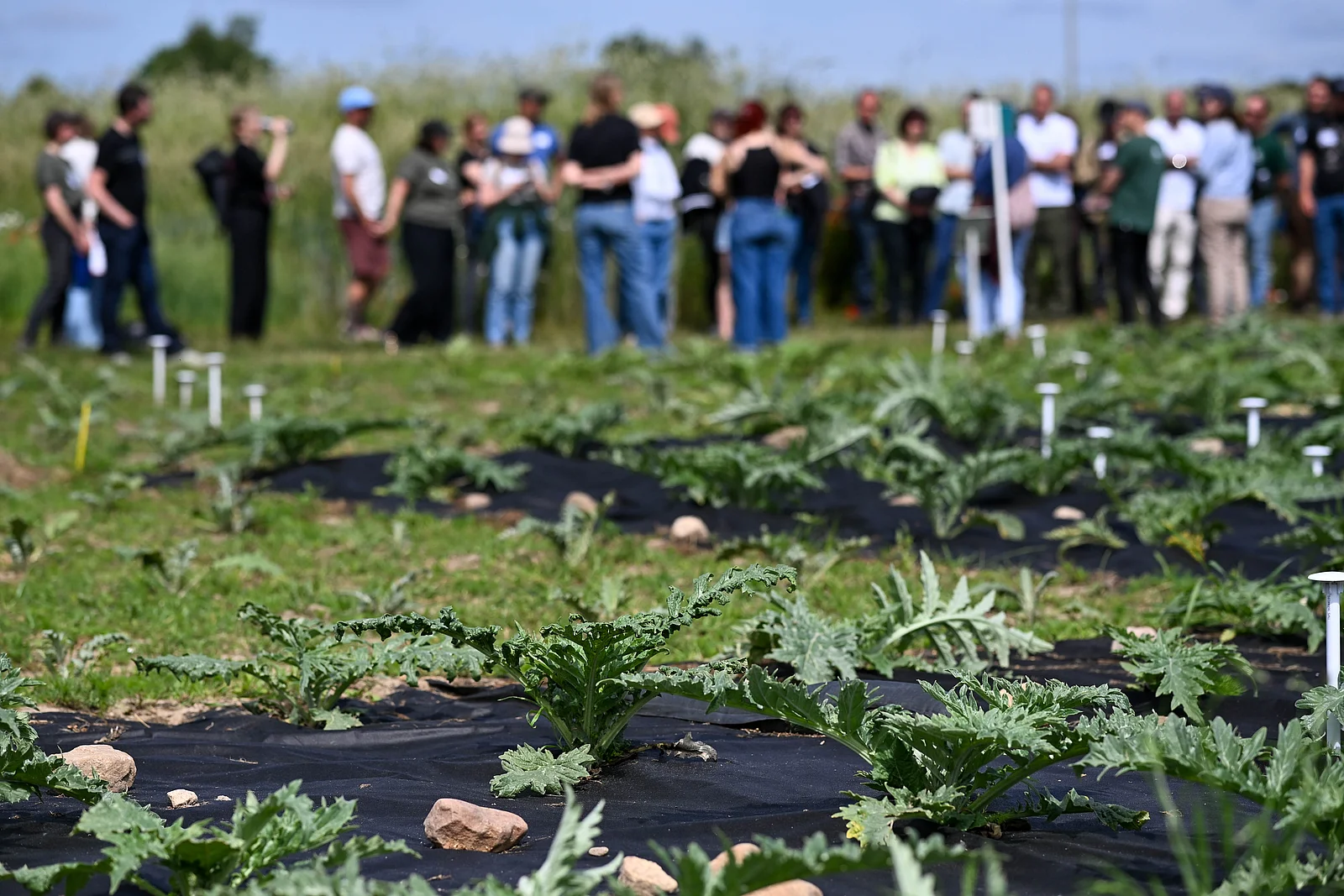
Entitled ‘Diversification with Pulses and Pseudocereals’, the annual event provided insights into the cultivation, processing and marketing of various crops. Once again, the field day was organised in collaboration with numerous partners from the region, including Gut Wilmersdorf, VERN, ZALF, Vermarktungsgesellschaft Bio-Bauern mbH and the Prowerta and LeguNet projects. It was aimed in particular at farmers, processors, advisers, project teams, researchers and, of course, students. The field day offers practical knowledge from a scientific perspective and provides a forum for discussion, particularly regarding regional value chains.
The programme centred on the presentation of plot trials involving crops such as quinoa, foxtail millet, chickpeas, soya, lupin, flat peas, dry beans, sunflowers, artichokes and cabbage. Another item on the programme for participants was a tour of the estate to view the arable crops at Gut Wilmersdorf. The diversity of the crops on display highlighted both the opportunities and the challenges associated with greater diversification in agricultural production.
This was also evident in the panel discussion ‘Pulses & Pseudocereals: Between Practice, Market and Policy’, which addressed questions regarding suitable framework conditions, viable marketing channels and the role of regional networks. It became clear that successful farm diversification involves more than simply growing additional or alternative crop varieties. A thorough examination of processing, advisory services, demand, political support and reliable market relationships is also part of a promising foundation for the diversification of agricultural holdings.
Another item on the programme was an open DAKIS® workshop. Here, participants were able to test a digital decision-support system for crop and farm planning that uses data to optimise the provision of ecosystem services.
Once again this year, the field day served as an important forum for exchange between practitioners, researchers and regional stakeholders. For crops that are of interest for more diverse crop rotations, new value chains and more sustainable food systems, knowledge transfer, testing and cooperation are essential. The Wilmersdorf Teaching and Research Station provided an excellent setting for this.