

From Eberswalde to the world: 20 years of the Global Change Management degree programme
From international climate policy to research and development cooperation, right through to sustainable supply chains: graduates of the Master's study programme in Global Change Management (GCM) at the Eberswalde University for Sustainable Development (HNEE) are now working around the world to tackle the challenges of global change. For 20 years, this English-taught Master's study programme has been equipping students to analyse complex environmental and societal changes and to help shape solutions. This anniversary provides an opportunity to look back on two decades of GCM – and at the paths that have led from Eberswalde into a wide variety of professional fields.
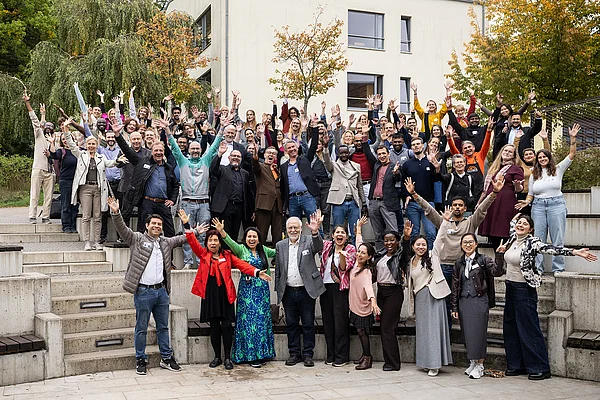
Große Resonanz bei GCM-Jubiläum: Alumni, Studierende, Lehrende und Wegbegleitende feiern gemeinsam 20 Jahre Global Change Management an der HNEE
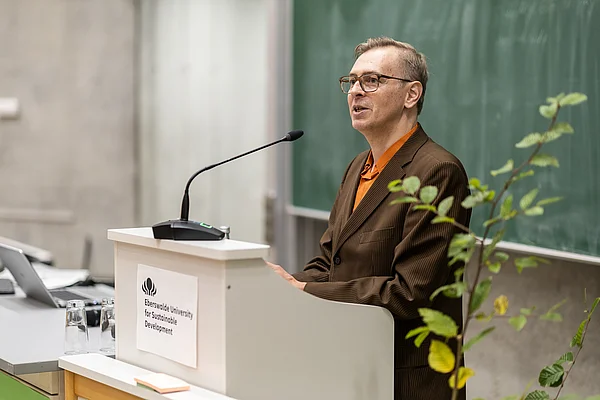
Studiengangsleiter Prof. Dr. Martin Welp begrüßt die Gäste zum 20-jährigen GCM-Jubiläum
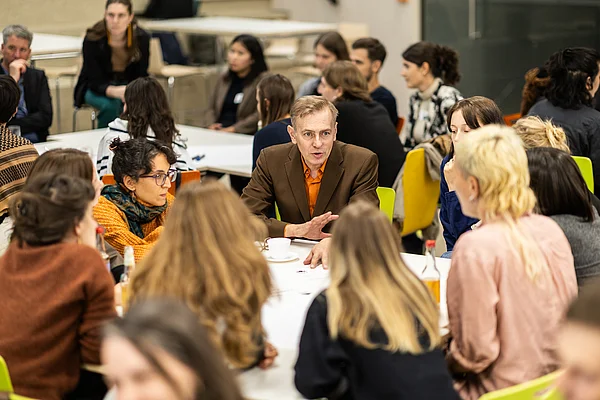
Gemeinsam den Studiengang weiterdenken: Im World Café tauschten sich Alumni, Studierende, Lehrende und weitere Wegbegleitende über die Zukunft von Global Change Management aus.
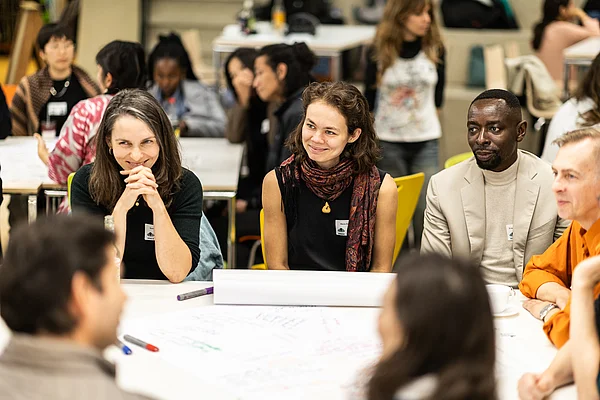
Gemeinsam den Studiengang weiterdenken: Im World Café tauschten sich Alumni, Studierende, Lehrende und weitere Wegbegleitende über die Zukunft von Global Change Management aus.
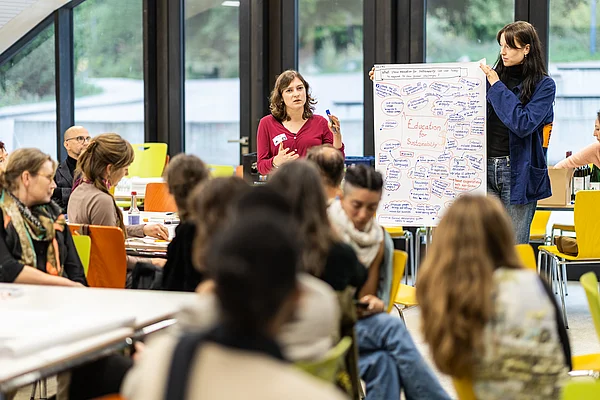
Gemeinsam den Studiengang weiterdenken: Im World Café tauschten sich Alumni, Studierende, Lehrende und weitere Wegbegleitende über die Zukunft von Global Change Management aus.
When the GCM Master's study programme was launched in 2006 at what was then Eberswalde University of Applied Sciences, the Paris Agreement was still nine years away. However, many of the challenges that dominate political and social debate today were already at the heart of the new degree programme back then: climate change, the loss of biodiversity and natural resources, and the question of how societies can cope with complex processes of change.
Twenty years on, these issues are more pressing than ever. What has changed is their scale, how they are perceived by society – and the professional fields in which answers to them are being sought. The career paths of the now numerous GCM graduates give an insight into this.
Gerrit Hansen was one of the degree programme’s early students. As early as 2008, she and her fellow student Eric Fee were awarded first prize in the university initiative ‘Zwischen Hörsaal und Projekt’ (Between the Lecture Hall and the Project). Today, Hansen works at the interface between climate research and international politics. Her career has included roles at the Potsdam Institute for Climate Impact Research (PIK), Germanwatch and the Robert Bosch Foundation; she was also involved in the work of the Intergovernmental Panel on Climate Change (IPCC). Today, she works, amongst other things, as a writer for the Earth Negotiations Bulletin published by the International Institute for Sustainable Development.
GCM graduate Jeraporn Rothong took a very different path into the world of international business. At Patagonia, she worked in the Social & Environmental Responsibility department, focusing on social and environmental conditions along global supply chains. Her work took her to production sites in Sri Lanka, Bangladesh, Thailand and India, where she helped, for example, to improve grievance mechanisms and working conditions for employees.
Carina Zell-Ziegler’s career path also illustrates how closely studies, research and one’s future career can be intertwined. As part of her GCM degree, she carried out research at Germanwatch into the extent to which the EU contributes to deforestation in Brazil and the associated CO₂ emissions through its imports of beef and soya. In 2013, she received the ‘Science Encouragement Award’ from the Gregor Louisoder Environmental Foundation for her Master’s thesis. Today, she is a Senior Researcher in the Energy and Climate Protection division at the Öko-Institut, where her work focuses, amongst other things, on sufficiency and climate policy instruments.
Three career paths that could hardly be more different – and yet all share the same starting point: the GCM Master's study programme at the HNEE.
A degree programme for complex questions
From the very beginning, GCM was designed to avoid viewing global environmental changes in isolation. Scientific interrelationships are linked with social, political and economic perspectives. Students learn to analyse complex systems, assess risks and develop strategies for processes of change.
The degree programme’s founding director was Prof. Dr Pierre L. Ibisch. Right from the planning stage, the degree programme emphasised collaboration with partners outside the university. To this day, institutions such as the Potsdam Institute for Climate Impact Research, Germanwatch, NABU, the German Society for International Cooperation (GIZ) and the Munich Re Foundation form part of the degree programme’s network. They contribute their expertise to teaching and open up opportunities for research projects and direct insight into various professional fields.
Work outside the lecture hall remains an important part of the programme to this day. As part of a research project, students deepen their specialist knowledge at an institution in Germany or abroad, whilst also gaining insights into potential future career paths.
Internationality has been part of the GCM concept from the very beginning. Half of the places on the programme are reserved for applicants from non-EU countries. As a result, diverse academic, cultural and social perspectives come together directly in Eberswalde – a diversity that shapes collaborative learning and which graduates later take with them into their professional lives in different parts of the world.
The degree programme’s international focus is also reflected in the awards won by its students. Between 2016 and 2020, the HNEE’s DAAD Prize was awarded to GCM students from Bangladesh, Uzbekistan, Albania, the United Kingdom and Mexico for five consecutive years. In 2024, Sander Claes from Belgium, another GCM student, was honoured with the prize.
After completing their studies, graduates apply their knowledge across a wide range of professional fields. GCM alumni work in research and policy consultancy, in government departments and specialist agencies, at international organisations, in non-governmental organisations such as Germanwatch and WWF, and in companies – including Weinrich Schokolade, which supports the degree programme. Their fields of activity range from climate protection and biodiversity through international cooperation to sustainable economic management. What many of these career paths have in common is a focus on social and environmental change processes.
One of them is Sönke Kreft. As Executive Director, this GCM alumnus now heads the Munich Climate Insurance Initiative at the Institute for Environment and Human Security of the United Nations University. Among other things, his work there focuses on approaches to better protect people and communities against the financial consequences of climate risks.
On 2 October 2026, former and current students, lecturers and partner organisations gathered at the HNEE’s Waldcampus to celebrate the degree programme’s 20th anniversary. The event was not merely a look back. Together, they discussed how GCM and sustainability education need to evolve in the face of new and intensifying challenges.
Head of study programme Prof. Dr Martin Welp and Founding Head of study programme Prof. Dr Pierre L. Ibisch looked back on the degree programme’s development and the global challenges that have accompanied it since its inception. Alumni and partner organisations shared their experiences; in a World Café session, perspectives for the coming years were developed.
Notes on the images:
The photos available here may be used for reporting purposes. Please note the copyright notice © HNEE | Florian Reischauer