ADAPT InnoForum: Climate – Forest – Timber Cluster
Research project
02/2023 - 01/2026
Competence field:Ecology, Biosphere reserves & protected areas, Sustainable forest management, Sustainable ecosystem management, Sustainable, site-adapted production systems, Wood as a raw material, Wood modification, Timber construction, Sustainability in decision-making processes and accountability structures, Education for sustainable development
Cooperation:Strategic cooperation, Practical partnership, Composite partnership
Funding partner:State funding, Federal funding
This innovative regional research cluster is being established at the HNE Eberswalde Waldcampus.
Led by Eberswalde University for Sustainable Development (HNEE), the cluster brings together the Eberswalde-based research institutions HNEE and the Thünen Institute of Forest Ecosystems with the experience and expertise of the knowledge transfer partner Eberswalde State Forestry Competence Centre, as well as the Max Planck Institute for Colloids and Interfaces and the Leibniz Centre for Agricultural Landscape Research (ZALF) e.V., in an innovation group of early-career researchers.
All consortium partners contribute their complementary expertise to the research cluster and the innovation group and collaborate in transdisciplinary modules.
Contact
Project manager
Prof. Dr. Tobias CremerProfessor of Forest Utilisation and Timber Markets
General contact
Dr. Ferreol Berendt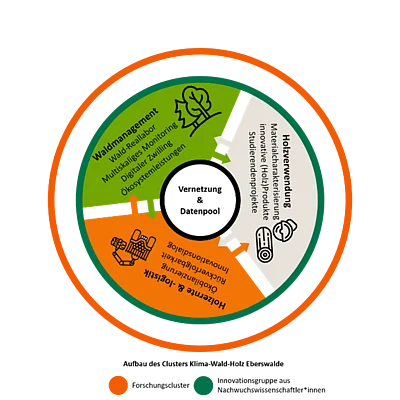
The planned research is divided into three main modules: (A) Adaptive Forest Management, (B) Timber Harvesting, Logistics and Data Integration, and (C) Innovative Uses of Timber in Construction.
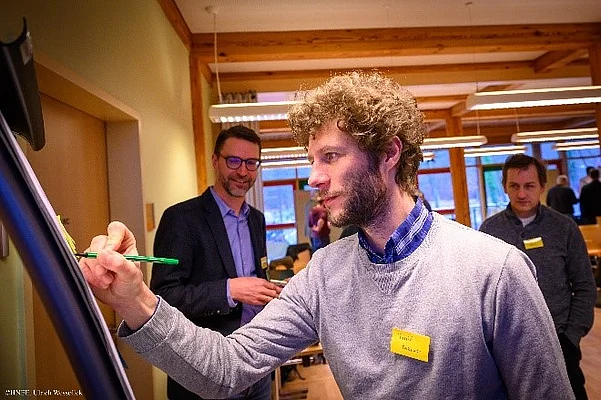
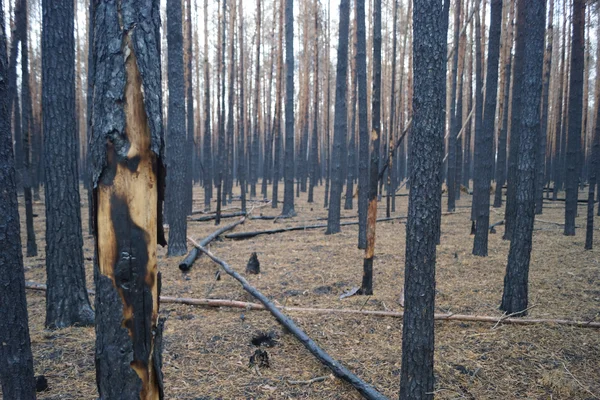
The establishment of an innovation forum (InnoForum Forest and Timber), bringing together stakeholders from the forestry and timber sectors with non-forestry stakeholders, will create a transfer-friendly environment in the region over the long term. The forum will develop the framework for a transferable, coherent strategy for managing the flow of timber. The objective is to achieve the greatest possible economic and ecological benefit, particularly for Scots pine, which will continue to be the dominant tree species in Brandenburg over the next two to three decades.
Funding partner
Federal funding
Partnerships
Network