Strategies for Developing Pyrophobic and Climate-Resilient Forests on Areas Affected by Forest Fires
Research project
05/2020 - 04/2025
Project volume:1.673.498 EURO
Cooperation:Composite partnership
Funding partner:State funding
Sub-project 1: Coordination, forest ecology and synthesis
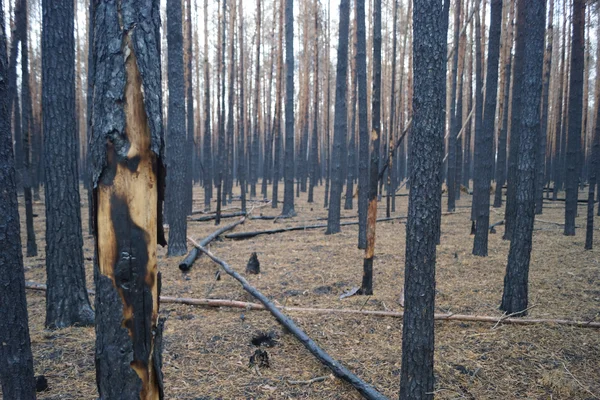
The collaborative project investigates the effects of different management approaches on the ecosystem development of areas affected by forest fires. Using long-term monitoring plots, areas with a history of fire are analysed, and the potential and effectiveness of natural regeneration processes within the ecosystem are assessed in order to formulate recommendations for managing fire-damaged areas. This also lays the foundation for long-term research, teaching and education on the subject. As a medium-term outcome of reforestation, the aim is to develop forests that are as resilient to climate change and as pyrophobic as possible.
Sub-Project 1, “Coordination, Forest Ecology and Synthesis”, is being carried out by the consortium coordinator (HNEE) and comprises Work Packages WP1 (Project Coordination & Project Management), WP2 (Site: Soil and Water), WP3 (Biotic Factors: Flora, Fauna, Mycology), WP4 (Forest Ecology & Restoration Management) and WP5 (Communication and Education).
This sub-project investigates tree regeneration and the biomass volume of lying deadwood, produces thermal maps, establishes a geodatabase and records the microclimate (WP3, Ibisch). Synthesising all project results from the individual sub-projects and deriving conclusions and concrete practical recommendations for forest ecosystem and restoration management are also central components of the sub-project (WP4, Ibisch). In addition, the composition of soil solution, seepage water and groundwater is investigated in this sub-project (WP2, Chmieleski). The transferability of the results and the applicability of the recommendations to forestry practice are discussed and optimised in collaboration with the LFE and communicated to specific target groups (WP5, Ibisch).
Information on the other sub-projects and project results is available from the project partners:
- Sub-project 2: Soil vegetation and soil moisture – University of Potsdam
- Sub-project 3: Properties of soil & soil fauna – BTU Cottbus-Senftenberg
- Sub-project 4: Forest structure, forest and forestry communication – Brandenburg State Forestry Agency – Eberswalde State Forestry Competence Centre
- Sub-project 5: Mycology: Monitoring of fruiting-body-forming fungal species, phytoparasites and mycorrhiza – Johann Heinrich von Thünen Institute, Federal Research Centre for Rural Areas, Forestry and Fisheries
- Sub-project 6: Effects of the management of burnt forest areas on moth communities – Senckenberg German Entomological Institute
- Sub-project 7: Forest structure, wildlife and breeding birds – Naturwald Akademie gGmbH
- Sub-project 8: Public relations and communication for the overall project – The Wilderness Foundation
An overview is provided by the Forest and Timber Competence and Information Centre (kiwuh) of the Agency for Renewable Resources (FNR)
Contact
Project manager
Prof. Dr. Pierre L. IbischProfessor of Socio-Ecology of Forest Ecosystems
General contact
Susanne RönnefarthFunding partner
Federal funding
Partnerships
Network partnerships