



Personalised course content
The programme consists of four semesters. A total of 30 ECTS credits must be completed each semester, comprising 18 ECTS credits from compulsory modules and a further selection of optional modules. Additional academic content, such as specialisation modules, is eligible for credit under the European Credit Transfer System. This results in a total of 120 ECTS credits for the Master’s programme in Forest Information Technology.
Modules per term
In the first semester, students are taught the fundamentals of innovative forestry IT and environmental informatics. In addition to the three compulsory modules, you will choose a further two compulsory-elective modules.
The module consists of the sections ‘Principles of Forest Data Structures’ and ‘Principles of GIS and Remote Sensing’.
You will acquire fundamental knowledge of forest data structures and their spatial and digital representation. You will become familiar with IT-based methods and techniques.
You will receive a practical introduction to the use of geodata and geotechnologies in ecological and sustainable forest management, as well as in applied forestry and environmental sciences in the broader sense. You will understand fundamental methods for the collection and processing of geodata.
They design algorithms and implement them using a programming language. They use computer programming techniques to analyse datasets from practical applications in environmental and forestry sciences. They develop programmes that handle different data types and structures, perform calculations and present the results visually.
The module consists of the sections ‘Forestry data structures and spatial data models’ and ‘Environmental spatial data analysis’.
You will be familiar with the theoretical foundations of data concepts and will be able to plan and implement databases for the processing of geodata. You will define and describe the key data structures and data types involved in the creation of geodata models and recognise the processing techniques required for different data types.
You will carry out statistical analyses of spatial environmental data. You will be able to select appropriate statistical methods and tests to identify structures and relationships within the data and to substantiate conclusions.
You will understand the carbon cycle, with particular reference to forests, soils and wood products. You will be able to develop and critically evaluate forest growth scenarios, and will have a basic understanding of how to set objectives for and carry out Life Cycle Assessments (LCA), Product Carbon Footprints (PCF) and Corporate Carbon Footprints (CCF).
You will be familiar with the basic methods and concepts of forest inventories at different spatial scales and will be able to collect comprehensive data on the condition and dynamics of forests for strategic and management-related planning.
You will gain an understanding of the fundamental principles of tree growth and tree physiology in relation to changing environmental conditions. On this basis, you will use the results of modern forest monitoring systems to assess forest productivity, carbon balances and the resilience of forests to changing environmental conditions.
You will critically evaluate the significance of long-term inventories and monitoring systems for decision-making processes in forestry and environmental sciences.
You will have a solid understanding of the fundamental concepts of biomass and carbon quantification, as well as their specific cycles. You will be familiar with the advantages of using remote sensing and modelling techniques for the spatial mapping and modelling of forest biomass at various scales. You will learn about various models for parameterising, quantifying or simulating carbon in forest biomass at the landscape level and discuss methods for quantifying forest biomass as well as for estimating carbon stocks and the associated uncertainties.
You will gain in-depth knowledge of projects, their planning and implementation, as well as various planning and implementation methods and tools. You will be able to plan and implement projects using both traditional and nature conservation-specific project planning tools. You will be able to take on various roles in project planning and implementation. You will be able to assess and reflect on project success, as well as identify opportunities for improvement.
The module consists of the sections ‘Geodata and Remote Sensing as Tools for Spatial Monitoring’ and ‘Basics in Monitoring and Research’.
You will be introduced to fundamental theoretical ideas and practice-oriented concepts for long-term monitoring in protected areas using geodata and remote sensing. You will learn methods of quantitative and spatial research, including interdisciplinary approaches, digital tools from citizen science, and communication via social media. You will apply empirical social research and spatial analysis from the perspective of various stakeholder groups.
You understand the basic principles of academic writing and presentation and are able to apply them. You are able to communicate effectively in an academic context.
The module consists of the sections ‘Sensors for automated measurements’ and ‘Process modelling methodology’.
You will identify and describe sensor technologies used in environmental modelling and understand the principles of data quality assessment and processing. You will gain an overview of ecosystem models and their application, with a focus on carbon dynamics, water and nutrient cycles, and biomass growth. You will learn modelling concepts, parameter estimation, model development and validation, and develop mathematical models for use in environmental sciences, forestry and ecology.
You will deepen your specialist knowledge and skills in a specific area. You will identify your own areas of focus within Forest Information Technology and explore approaches from related degree programmes.
You will spend the second semester studying at the Warsaw University of Life Sciences. You will learn how to apply information technology (IT) to forestry and environmental subjects and topics related to forestry. In addition to the three compulsory modules, you will choose two further compulsory-elective modules.
- Sustainable forestry
- Data processing and programming
- Data collection and processing technology
Possible compulsory elective modules include, for example:
- Scientific Principles: Presentation and planning skills
- Scientific Principles: Language and social skills
- Forest biometry, biomass and tree-ring analysis
- Principles of landscape ecology
- LiDAR data processing and geostatistical methods in forestry
- Sustainable forest management & forest products
- Specialisation module
During the third semester at one of the two campuses, you will undertake an independent research project, supported by a range of compulsory-elective modules. You will choose two compulsory-elective modules.
The research project consists of a scientific or technical research project and a scientific colloquium.
You will be equipped to plan and carry out a specific, medium-scale research project and consolidate your academic maturity in relation to your chosen specialisation. You will be able to discover new areas of IT applications, expand and demonstrate your ability to carry out academic work, including academic writing and the peer review of academic papers in a virtual online seminar.
Possible compulsory elective modules include, for example:
- Advanced Remote Sensing Innovations (ARSI)
- Advanced LiDAR data analysis
- Big Data Analytics
- Machine Learning and Data-Driven Modelling
- Innovative Forest Management Methods
Possible compulsory elective modules include, for example:
- Innovative economy, policy and social sciences in forestry
- Natural resources & conservation
- Information & mathematical models
- Environmental monitoring
Possible compulsory elective modules include, for example:
- Learning by doing: Adaptive Management
- Forest Pests & Diseases
- Genetic Resources Conservation and Molecular Markers
Students may also choose modules from other forestry-specific Master’s programmes for their specialised studies, such as Forestry System Transformation.
In the fourth semester, you will work on your Master’s thesis at both campuses, supplemented by a further compulsory elective module.
You will develop further skills in interdisciplinary academic work. You will be able to evaluate research projects and communicate the findings to a specialist audience.
You will produce your own research findings by solving and discussing a scientific problem. You will present the findings of your Master’s thesis and be able to defend the underlying assumptions, methods and the robustness of the key findings.
Possible compulsory elective modules include, for example:
- Applied Big Data Analytics
- Advanced Programming
Possible compulsory elective modules include, for example:
- Climate change impacts on plant growth and crop yield: non-invasive monitoring methods
- Advanced data mining techniques
Students may also choose modules from other forestry-specific Master’s programmes for their specialised studies, such as Forestry System Transformation.
FAQ: Course Content
The modules and research project in the third semester always include a practical component as part of the curriculum.
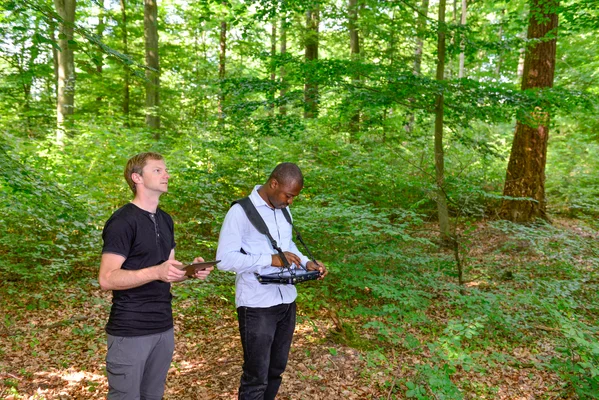
You will learn how to use various software programmes that deal with FIT topics. The course is enriched by numerous field trips to the forest, to monitoring stations or to the Marteloscope sites.
Yes, the FIT team provides detailed information on the FIT FAQ page on Moodle. Students gain access to this page once they have enrolled.
The FIT degree programme in Eberswalde and Warsaw skilfully combines the acquisition of specialist knowledge with technical skills. It is particularly the practical application and the theoretical modules that set FIT apart from other master’s programmes.
Mansour Mahamane
Student of Information Technology