Climate-Resilient Woody Crops for Agroforestry Systems in Drought-Prone Regions
Research project
03/2025 - 02/2028
Project volume:294.721 EURO
Competence field:Sustainable, site-adapted production systems, Agroforestry systems
Cooperation:Practical partnership
Funding partner:Foundation funding
Department:FG Agrarökologie & nachhaltige Anbausysteme
This three-year research project investigates how the successful establishment of woody plants in agroforestry systems can be achieved under increasingly extreme climatic conditions. The aim of the project is to address existing knowledge gaps regarding climate-resilient tree species and varieties, as well as practical planting stock, through field experiments. The research will contribute to developing knowledge on the successful establishment of woody plant stands with long-term plant health and consistent growth, thereby reducing the need for replanting in agroforestry systems. The results will be made accessible to experts and practitioners in land management, supporting the future establishment of agroforestry systems in a “risk-minimised” and successful manner.
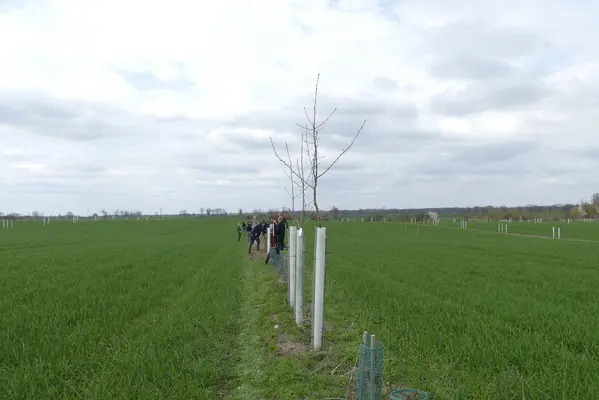
In December 2025, silvo-arable alley-cropping agroforestry systems were established as randomised block designs in on-farm trials at three commercial farms (Warnke Agrar GmbH, Biohof Kepos – Frank Rumpe, and Sonnengut Gerster). All three sites are characterised by relatively low precipitation and increasing spring drought, while also differing in their specific site conditions, such as soil types.
The project is testing grafted walnut trees, grafted sweet chestnut trees, and mulberry seedlings from different propagation systems (AirPot, bare-root, and container-grown). In addition to the tree species and propagation systems, complementary trials are investigating different walnut, sweet chestnut, and mulberry varieties, as well as direct sowing of sweet chestnuts and spring planting of mulberries using planting cartridges compared with container planting.
Throughout the project, data on tree development, mortality rates, photosynthetic activity, and root growth will be collected and analysed, among other parameters.
Alongside this research, a survey was conducted among farms in the drought-affected regions of eastern Germany that already have experience in establishing walnut, sweet chestnut and/or mulberry trees in agroforestry systems.
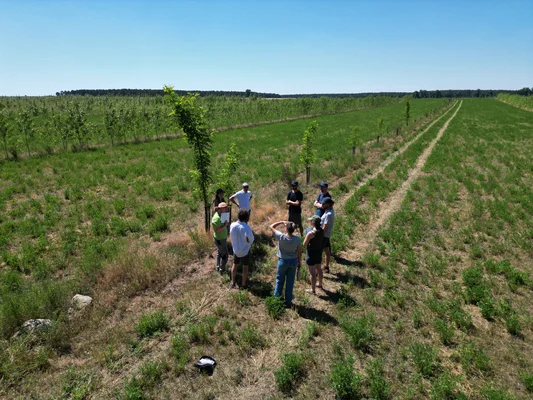
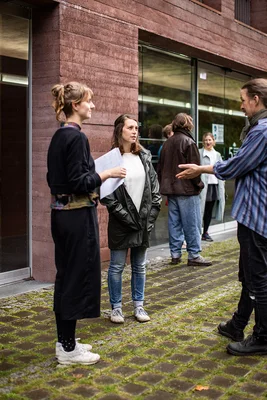
Our project partners at the trial site.
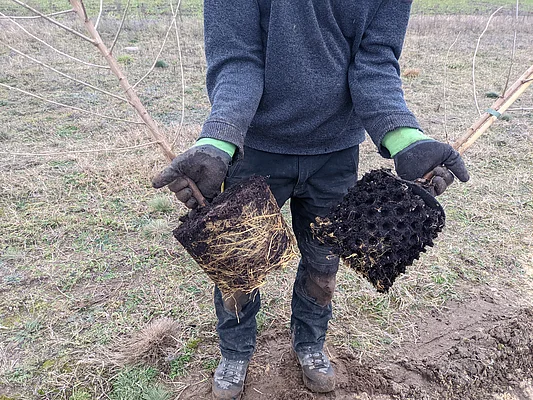
The mulberry tree on the left was grown in a container, while the one on the right was grown in an AirPot.
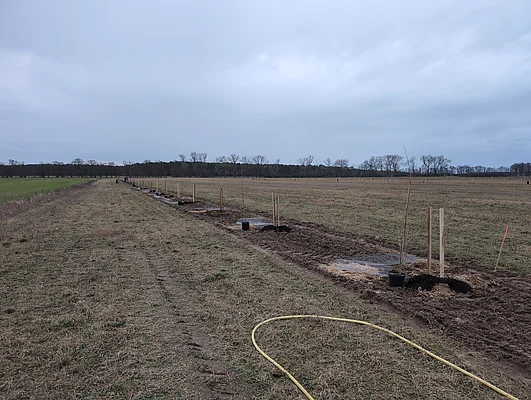
Trial site.
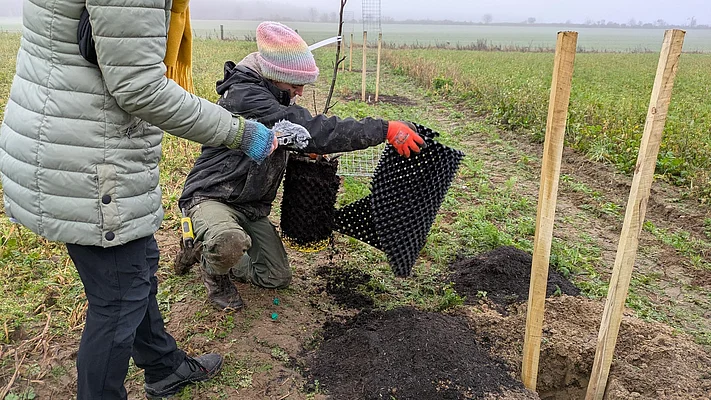
A walnut tree is being planted at Biohof Kepos.
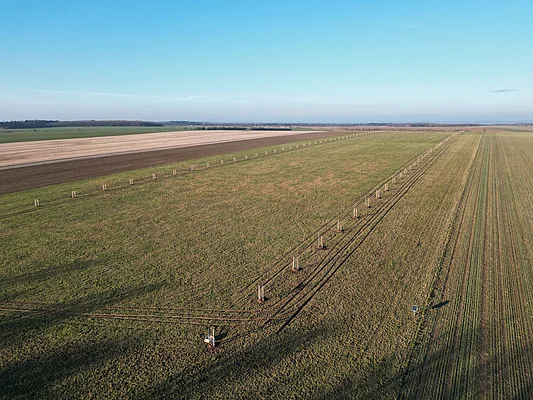
Sonnengut Gerster
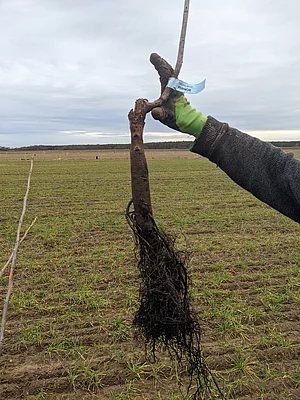
The Fernor variety before planting.
Contact
General contact
Leonie SteinherrResearch Associate in the Department of Agroecology and Sustainable Cropping Systems
Project manager
Prof. Dr. Ralf BlochProfessorship in Agroecology and Sustainable Cropping Systems
Professor of Forest Utilisation and Timber Markets
Funding partner
Foundations

Partnerships
Practice partnerships