

Centre for Data Science
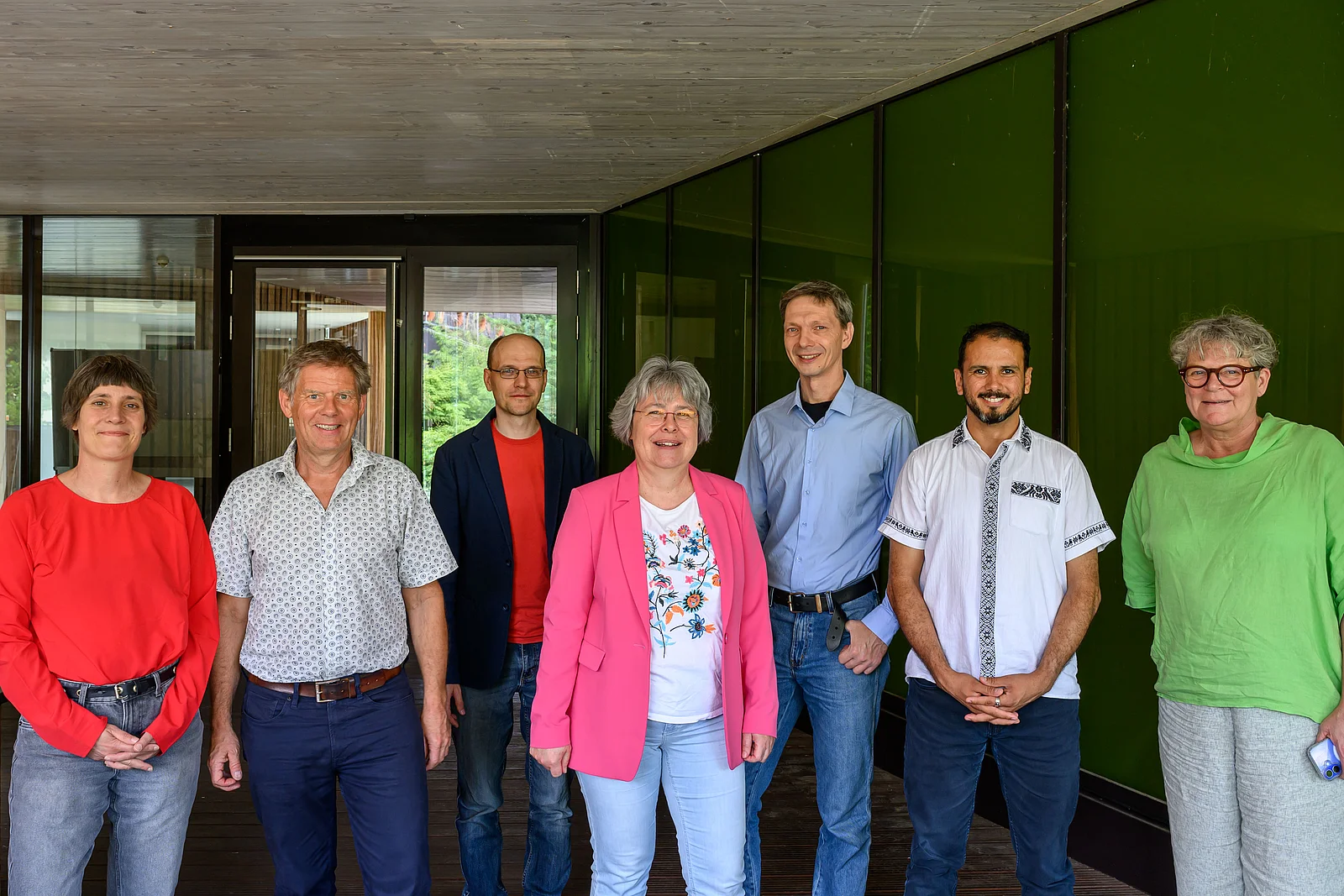
Who hasn't heard of self-driving cars or intelligent voice assistants? Whether weak or strong artificial intelligence (AI), all processes usually require the processing of large amounts of data. At HNEE, we also work with data to find answers to our research questions. To this end, the Centre for Data Science (C4DS) brings together the university's expertise in data science methods and procedures and provides a forum for open exchange and coordination of research activities. The centre is currently supported by eight members from both departments, and we look forward to welcoming further academic staff and professors.

Mission statement
We are an association of motivated university members who represent the field of data and data science in the form of the Centre for Data Science at the University of Applied Sciences for Sustainable Development and beyond. We are convinced that working with data is a key skill.
We work together in research, teaching and transfer to further develop the understanding of data and data-based applications: collecting, gathering, understanding, applying, critically questioning, analysing and visualising data – in short: promoting data literacy as a basis for sustainable transformation.
What unites us is constructive, interdisciplinary cooperation, a shared infrastructure, creative methods and binding self-organisation. The diversity of our technical expertise is an outstanding strength that we use to inspire both within the university and beyond, in society, science and business. Together, we address transdisciplinary questions of sustainability in order to use data science for a sustainable society through innovative applications.
Objectives
- We create a cooperative working environment that offers the university community and society the opportunity to work with us on data-driven solutions to their problems. We contribute our knowledge and expertise with the aim of advancing the skills and abilities required to work with data.
- We leverage internal synergies and strengthen the application of data science by pooling our expertise. This also contributes to the acquisition of joint projects, which help us to ensure the collaborative operation of the infrastructure.
- We have an impact on the university community and beyond – lifelong learning, inspiring work with data. In doing so, we also consider the associated social implications of using technology. We see data skills as key qualifications and the basis for sustainable transformation, taking into account social implications and technological developments.
- We promote and establish the awareness and visibility of Eberswalde and the HNEE in the teaching and research landscape as a place of data work for sustainability.
- We investigate developments in digitalisation and artificial intelligence with regard to their effects and impacts on nature, the economy and society.
Values
We regard these values as the foundation of C4DS, promoting the achievement of our goals.
- Interdisciplinary and collaborative cooperation
We see ourselves as an interdisciplinary community that works together in an open, empathetic, appreciative, creative and reflective manner. - Scientific approach
Our approach is characterised by accuracy, rigour, clarity and integrity. A benevolent culture of error makes our community capable of learning. - Inspiration
We inspire with and through our work in research, teaching and transfer, and we are equally inspired by new ideas. - Autonomy Self-organisation
is key – we focus on our sphere of influence in our projects and exercise this influence in a self-determined manner. - Integrity
Transparency, commitment, an appreciative and constructive approach, and a sense of responsibility characterise our actions.
This is us
Gudrun Ahn-Ercan
Gudrun Ahn-Ercan is Professor Emerita of Numerical Mathematics and Applied Statistics. She is a champion of data-driven scientific research and the integration of numerical mathematics and mathematical statistics. Using vector and matrix algebra, numerical mathematics enables the behaviour of observation systems to be described on the basis of data sets collected through measurement. Sampling measurements in observational systems are, in turn, subject to random measurement deviations, which can be calculated using the tools of statistics and probability theory. In timber research, for example, springback effects in moulded laminated timber are investigated. To this end, measurement data collected from curved test specimens form the raw data for the mathematical and statistical derivation of the springback formula. This then enables the production of shaped timber laminates for specific curved forms in bar counter construction or modern furniture making (ORCID).
Claudia Brözel
Claudia Brözel heads the Sustainable Tourism Management degree programme at HNEE. As the tourism industry is highly data-driven, two years ago she worked with colleagues from the Centre for Data Science to firmly embed the mandatory module ‘Data Literacy’ and the elective module ‘Applied Data Science in Tourism’ within the curriculum. Her research focuses on how business models in tourism are changing as a result of digitalisation and artificial intelligence. She also looks at social entrepreneurship and gender justice in the tourism sector. At the Centre for Data Science, she thus brings the perspective of a data-intensive yet socially and environmentally oriented tourism industry (ORCID).
Markus G. Jahreis
Luis Carlos Miranda
Luis Carlos Miranda obtained his PhD in Agricultural Sciences at Humboldt University in Berlin, having previously completed his degree in Electronic Engineering and Water Sciences in Mexico. His professional focus lies at the interface between hardware and analysis: the practical instrumentation and the evaluation of the data obtained. He has been involved in various projects in this field, including in crop production (tomatoes, strawberries), livestock farming (dairy cows) and, currently, forestry. At the Centre for Data Science (C4DS), he heads the HNEE’s X-ray tomography laboratory, organises the weekly Machine Learning Meetup and is committed to promoting data and graph literacy. He is also actively involved in the work of the CIGR International Commission of Agricultural and Biosystems Engineering.
Jens Müller
Jens Müller brings to the Centre his background in machine learning for data science applications from the HNEE. He is currently setting up the AI Sustainability Laboratory. He also organises members’ meetings and Data Cinema, as well as coordinating other activities. Jens Müller studied Computer Science at the HU Berlin and obtained his PhD from Friedrich Schiller University Jena with a thesis entitled ‘Generative Solver Construction for Machine Learning Problems’.
Jan-Peter Mund
Peter Neumeister
Kirstin Vach
Evelyn Wallor
Evelyn Wallor is a research assistant specialising in the prediction and analysis of ecosystem dynamics through process modelling. After studying agricultural and plant sciences at Humboldt University in Berlin, she completed her PhD on the hydrological modelling of managed peatland sites. After several years of research work at various institutions and on different projects, she is now based at the HNEE. She incorporates her experience in research and computer-aided modelling into her teaching, enabling students to gain practical experience of these methods both in the classroom and through student projects (ORCID).
Research projects


Service
Statistical Consultancy Services
The statistics consultancy service is available to all students, lecturers and researchers at HNEE, whether they are working on Bachelor’s theses, Master’s theses or larger research projects. It is advisable to seek advice as early as the planning stage of your work, as errors in planning often lead to inconclusive results. Consultations relating to any kind of thesis should be discussed in advance with your supervisor. Please feel free to contact Kristin Vach directly or email statistikberatung(at)hnee.de to arrange an initial appointment. I, or a member of staff from the Centre for Data Science, will be happy to assist you in resolving your statistical problem.
Contact
You can contact the members at CenterForDataScience(at)hnee.de.
Events
All events can be subscribed to in the calendar of the Centre for Data Science. The open-university member meeting takes place every first Wednesday of the quarter.