DAAD East-West-Dialogue Programme 2020
Research project
01/2020 - 12/2020
Competence field:Sustainable forest management, Sustainable ecosystem management
Cooperation:Strategic cooperation
Funding partner:State funding
Department:Department Wald - Holz - Umwelt
Eastern Europe in the VUCA World – Transboundary Learning in UNESCO Biosphere Regions for Sustainable Development under Global Change and Increasing Uncertainty
Our world seems to be less predictable than it used to be. Increasing Volatility, Uncertainty, Complexity and Ambiguity (VUCA conditions) endanger the implementation of sustainable development. The VUCA concept was first introduced by the US military after the end of the Cold War to describe the conditions of a world that is increasingly difficult to predict and reliable. Since its first appearance in the 1990s, the concept has quickly been adopted by other areas such as strategic decisions, risk management and situational problem solving. We, here, apply it to the context of sustainable development in Eastern Europe.
Contact
Project manager
Prof. Dr. Pierre L. IbischProfessor of Socio-Ecology of Forest Ecosystems
General contact
Angela Dichte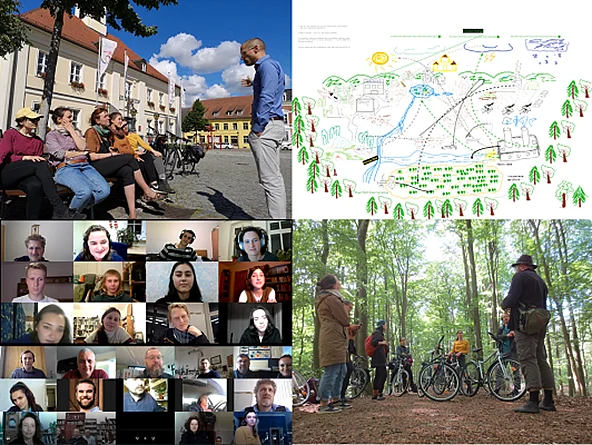
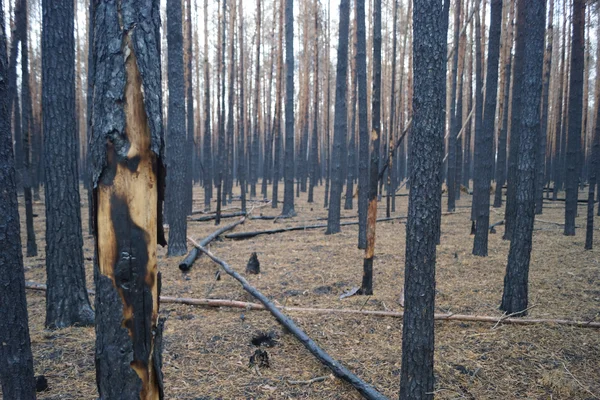
Due to the effects of climate change and unsustainable land use, the world is facing tree dieback and other threats that affect the resistance and resilience of forests. Very recently, several thousand hectares of forest have been burning in Ukraine (in the area around Chernobyl).
Cooperation between international partners is essential for studying the changes taking place that affect ecosystems and for sharing knowledge on potential strategies. The project aims to strengthen cross-border cooperation in research into climate adaptation measures in forests, with a focus on UNESCO Biosphere Reserves as living laboratories for sustainable development. The project focuses on the border region of three countries: Ukraine, the Republic of Moldova and Romania. The project partners come from academia as well as from the management bodies of UNESCO Biosphere Reserves, whose management has a direct influence on the project region.
A particular strength of the regional project partners is that they have already collaborated on previous projects (see below) and can therefore build on a solid foundation of cooperation.
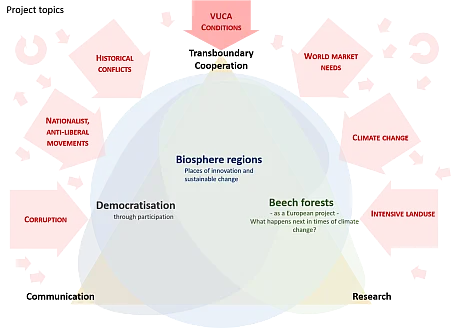
The general priorities of the projects are
- Transboundary cooperation
- Research
- Communication
With a particular focus this year on
- Democratisation
- Biosphere regions
- Beech forests
Goals
The project focuses on beech forest ecosystems as part of Europe’s natural heritage and their ability to adapt to climate change; on the UNESCO Biosphere Reserves as centres of innovation and sustainable development, with a focus on change management; and on strengthening democratic developments in the participating countries through effective participation. Key challenges in the region are of a political nature and also include historical conflicts, poverty and severe economic hardship, climate change, and intensive land use. The project aims to tackle these challenges through communication, research and cross-border cooperation.
Project measures originally planned and measures adapted in response to the COVID-19 situation
Originally, we had planned an international study trip to Ukraine in May 2020 and a joint seminar in Moldova in the autumn, as well as research and study visits. Due to the new circumstances arising from the COVID-19 pandemic, the project adapted its measures to suit the current situation.
Virtual Excursion
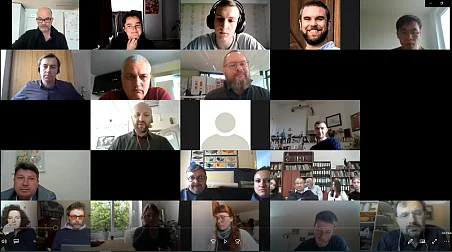
Due to travel and contact restrictions in the context of the COVID-19 pandemic, a virtual excursion took place from 25 to 29 May 2020 instead of the planned annual study trip to Western Ukraine. To this end, several videos featuring the lecturers and partners were produced in advance, which were watched and discussed during the week.
These videos, together with the information and discussions during the online Zoom meetings, then formed the basis for further video and literature research on topics relating to transformation research, the development of Ukraine, Moldova and Romania, and the management of ecosystems and biosphere reserves in these countries. The 45 international students worked in mixed groups. The results of their work were presented in videos they produced themselves.
Of course, this could not fully replace an actual visit to the ecosystems and partners on site, but the use of digital media and communication channels also opened up new avenues for the project and cooperation with the partners.
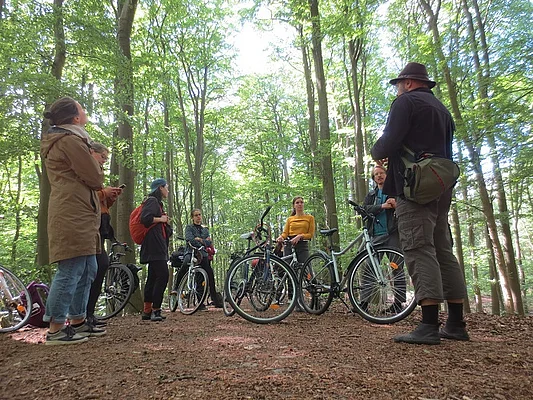
Bike excursion to the Grumsin forest in the BR Schorfheide-Chorin
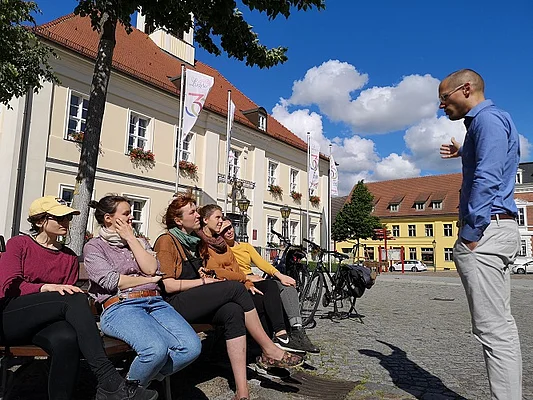
Students in exchange with the mayor of Angermünde
International Online Seminar
Exploring the role of biosphere regions in a VUCA world
The second activity took place from Friday 13 November to Monday 30 November. Originally planned as a field trip-based seminar in Moldova on the topic of biosphere reserves in autumn 2020, the format had to be adapted for an online version as well.
The overall duration of the activity was extended, the length of the individual sessions was reduced, and the regional focus was shifted. Five students from Ukraine, six students from Moldova and five students from Germany took part in this seminar. To strengthen the students’ personal connection to the topic under discussion, it was decided that students would no longer all work on the case of the (BR) Lower Prut, but rather on their respective nearby biosphere reserves: in Ukraine, the Roztochya BR; in Moldova, the Lower Prut BR; and in Germany, the Schorfheide-Chorin BR.
As it was not possible to gain any practical experience on site, the aim was to structure the collaborative work to include as much fun, interaction and creativity as possible. Thus, the focus was not so much on technical input – although this was, of course, essential – but was to be shaped through the joint development of a ‘Picture of Landscape’ (Bild der Landschaft) that invites reflection on connections and causalities within the wider landscape. To this end, the students were asked to adopt the perspectives of different stakeholders in a kind of role-play. Based on these reflections, the students were eventually to develop project ideas and, where possible, plan the next steps for their implementation.
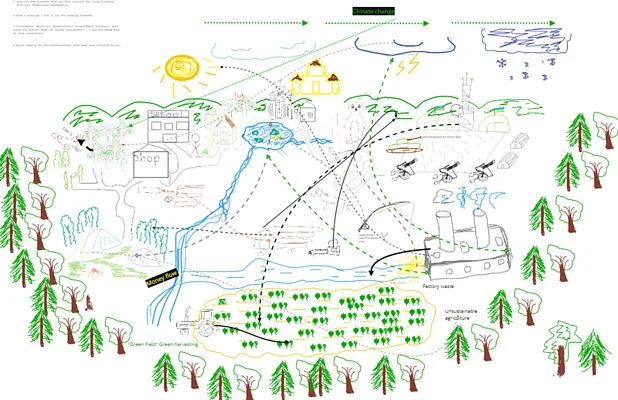
One of the Pictures of Landscape (BR Roztochya) created in miro.com
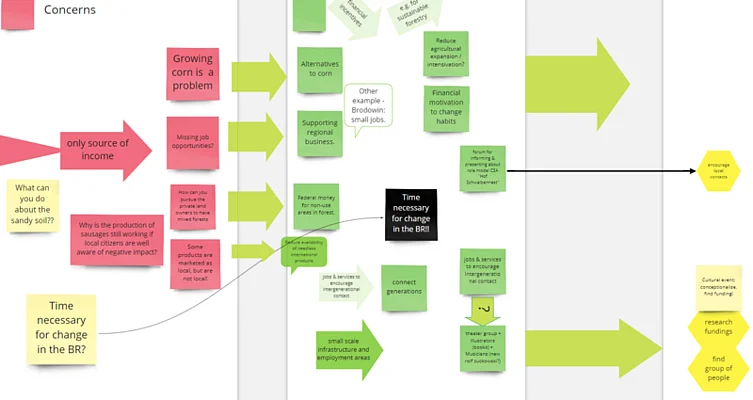
One of the project idea results (BR Schorfheide-Chorin) created in miro.com
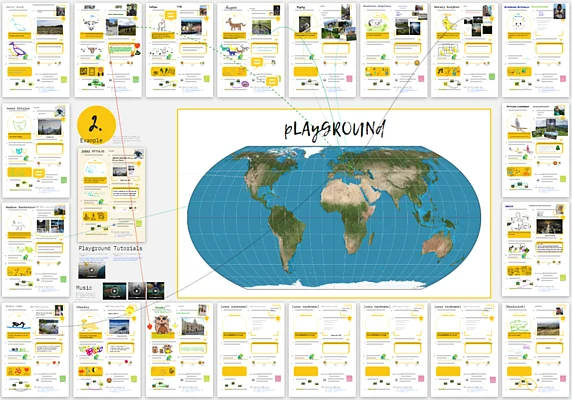
One of the creative playgrounds for the participants - created in miro.com
Funding bodies

Partner organisations